Jupiter — Cloud Bands
The closest gas giant, captured as it actually looks through a small telescope
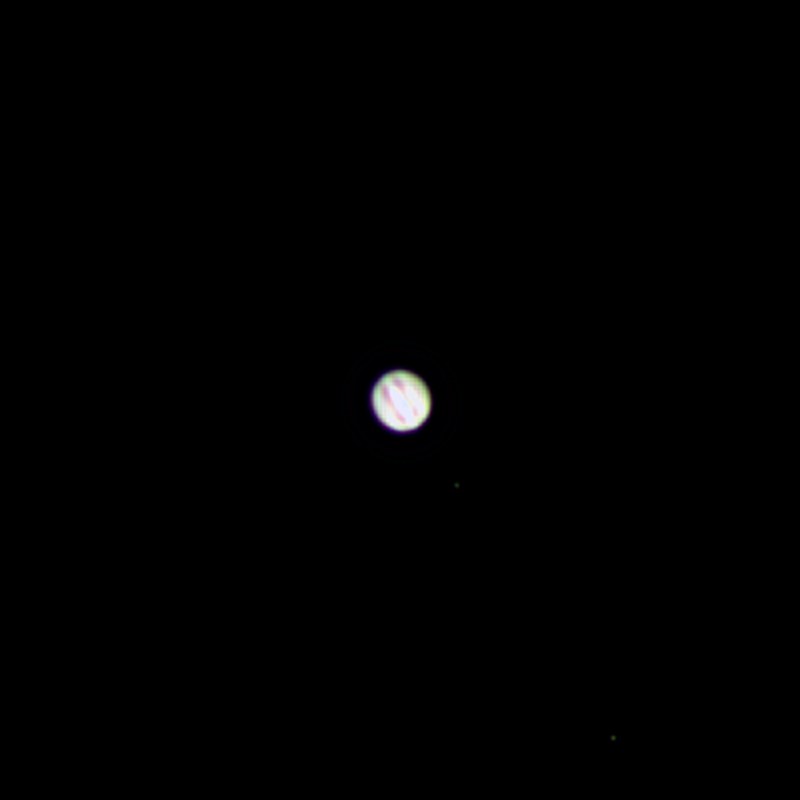
 Darth Vader (ZWO Seestar S50, Solar System mode, video stacking)
What you're looking at
Jupiter is the largest planet in the Solar System — about 318 times the mass of Earth and roughly 11 times wider. The cream and tan bands across its surface are the planet's upper atmosphere, organized by Jupiter's incredibly fast rotation (one Jovian day is just under 10 hours) into stable parallel belts and zones.
What looks like a small disk in this frame is the actual angular size of Jupiter as seen from Earth at capture — well under an arcminute across, a fraction of the apparent size of the moon. The Seestar's wide field of view is built for galaxies and nebulae; planets always look small here, regardless of conditions.
The two horizontal bands you can resolve here are the North Equatorial Belt and South Equatorial Belt — the planet's most prominent atmospheric features. The Great Red Spot, a 350-year-old storm twice the size of Earth, isn't visible in this particular capture because it was on the far side of Jupiter when the image was taken.
The lesson
It's not a solid thing — it's a fluid in equilibrium with itself.
What looks like a striped marble is a layer of clouds organized by rotational dynamics into stable bands that have persisted for as long as we've been watching. Underneath that visible layer is more hydrogen, more helium, more clouds, all the way down to a slushy metallic-hydrogen interior with no clear surface anywhere.
There's no "there" to Jupiter. The pattern *is* the planet.
One photo. One lesson.
New entries land when the sky cooperates. Get them by email, plus the Sitreps jobs newsletter — no schedule, no spam. Unsubscribe from either one anytime.
Object data
- Object type
- Gas giant planet
- Distance (at capture)
- ~407 million miles
- Angular size (at capture)
- ~44 arcseconds
- Diameter
- ~88,846 mi (≈11× Earth)
- Mass
- ~318× Earth
- Rotation period
- 9h 56m (fastest in the Solar System)
- Visible features
- North + South Equatorial Belts
- Not visible in this frame
- Great Red Spot (on far side at capture)