Jupiter and the Galilean Moons
What Galileo saw in January 1610 that changed everything
 Darth Vader (ZWO Seestar S50)
What you're looking at
On the night of January 7, 1610, Galileo Galilei pointed a 30x refractor at Jupiter and saw three small "stars" near it. Over the following nights, the stars moved — they were orbiting Jupiter. He had discovered the first moons of another planet ever observed: Io, Europa, Ganymede, and Callisto, now known as the Galilean moons.
It was a problem for the Earth-centered model of the universe. Before 1610, the dominant cosmology held that everything in the heavens revolved around the Earth. Galileo's moons orbited Jupiter, not Earth. There was something else for things to orbit around. That single observation, more than any argument, is what eventually killed the geocentric model.
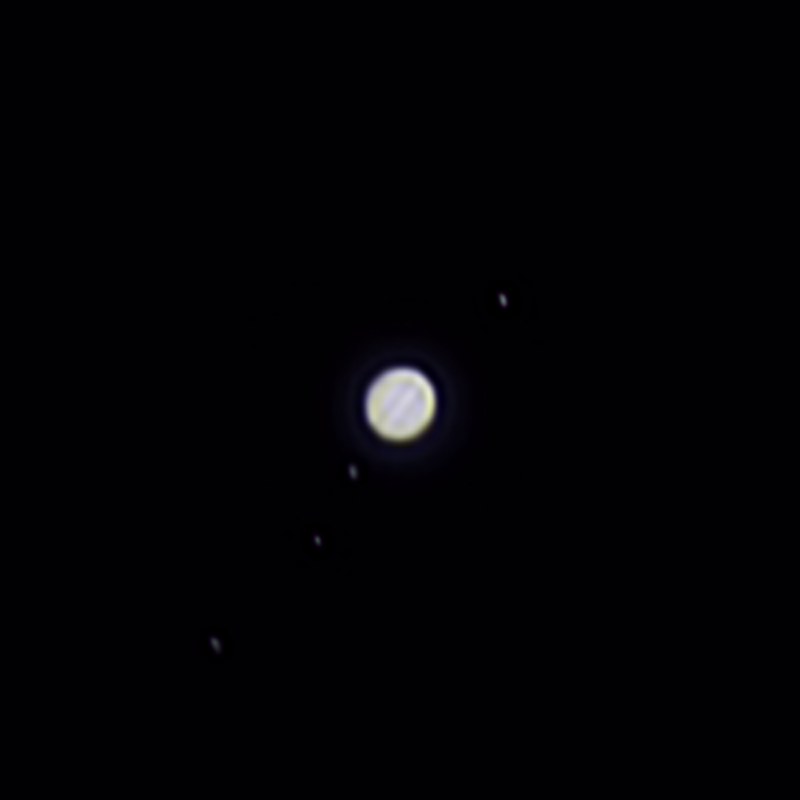
The disk in the center of this image is Jupiter with its equatorial belts visible, and the four small points strung diagonally around it are the Galilean moons — the same four worlds Galileo saw 416 years ago, in approximately the same arrangement as they appeared to him on some night between January and March of 1610.
This is a recreation of the most consequential telescope view in the history of astronomy, taken from a backyard in Texas with a $500 robotic scope. Galileo would have been incomprehensibly jealous of the gear and probably equally amazed that we still do this for fun.
The lesson
Sometimes the small dots are the part of the picture that matters.
Jupiter is the bright center of this image. The moons are the small ones off to the side, easy to overlook if you don't know what you're looking for. But the moons are the part that revolutionized our understanding of where we live in the universe.
The brightest thing in a picture is rarely the most important thing in it. Train yourself to look at what's small.
One photo. One lesson.
New entries land when the sky cooperates. Get them by email, plus the Sitreps jobs newsletter — no schedule, no spam. Unsubscribe from either one anytime.
Object data
- Object
- Jupiter + Galilean moons (Io, Europa, Ganymede, Callisto)
- Discovery of moons
- January 1610 · Galileo Galilei
- Visible moons in this frame
- All four
- Moon diameters
- Ganymede 3,270 mi (larger than Mercury) · Io 2,264 mi · Europa 1,940 mi · Callisto 2,995 mi
- Distance (at capture)
- ~388 million miles
- Historical impact
- First observation of objects orbiting something other than Earth