
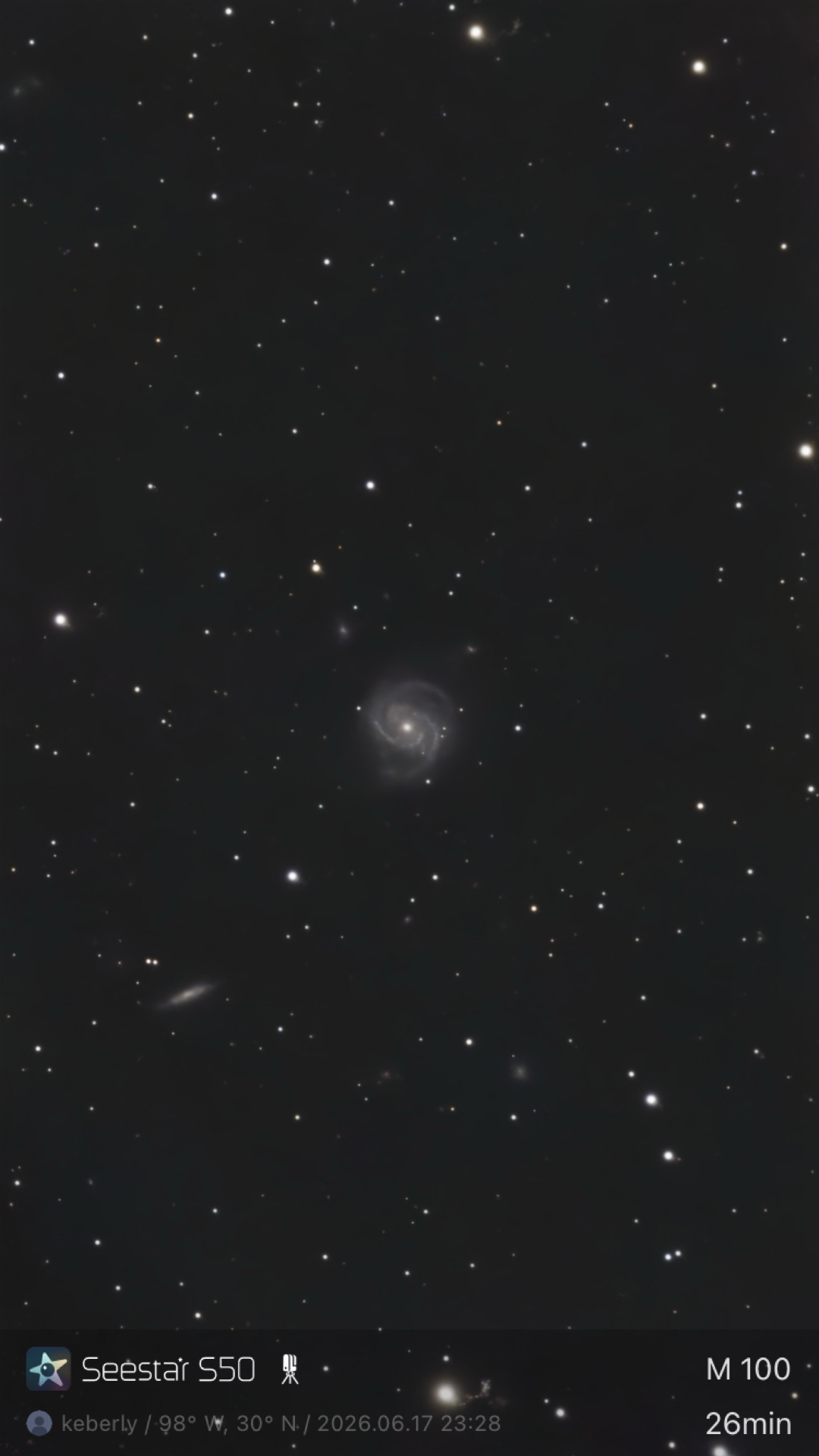
M100 — Face-On Spiral in the Virgo Cluster
A near-twin of the Milky Way, 55 million light years away
What you're looking at
M100 is a face-on spiral galaxy about 55 million light years away in the constellation Coma Berenices. It's one of the brightest members of the Virgo Cluster — the gravitationally-bound family of more than 1,300 galaxies that anchors our Local Supercluster.
At roughly 107,000 light years across, M100 is almost the same size as the Milky Way. Looking at this image is approximately what an observer in M100 would see if they pointed a similar telescope back at us: a slightly bigger face-on spiral with a bright core and resolved arms.
The edge-on galaxy in the lower-left of the frame is most likely NGC 4312, a smaller Virgo Cluster satellite. Several other faint fuzzy patches scattered through the field are additional cluster members — the Virgo Cluster is dense enough that a wide-field shot of any one galaxy in it usually catches multiple others for free.
Notable detail in the capture: at only 26 minutes of integration, this image already shows arm structure that would have taken multiple hours from a typical suburban backyard. Bahía de los Ángeles sits inside a designated Mexican biosphere reserve with effectively zero artificial light — Bortle class 2 or better. The dark sky did most of the work the integration time normally would.
The lesson
Sometimes the answer isn't more time — it's a different place to start from.
This image was 26 minutes of total integration. From my usual backyard in suburban Texas, the same target with the same telescope needs roughly 4 hours to look anywhere close. The Bortle 6 sky over Austin throws away ~90% of the signal before any photon ever reaches the sensor. The Bortle 2 sky over the Sea of Cortez throws away almost none.
Same gear, same hands, same target. Different location, ten times the result. The bottleneck wasn't effort. It was where the work was happening.
Object data
- Catalog
- M100 · NGC 4321
- Constellation
- Coma Berenices
- Type
- Intermediate face-on spiral (SAB(s)bc)
- Distance
- ~55 million light-years
- Diameter
- ~107,000 light-years (≈Milky Way)
- Cluster
- Virgo Cluster (one of the brightest members)
- Likely companion in frame
- NGC 4312 (edge-on, lower-left)
- Discovery
- 1781 · Pierre Méchain