M101 — The Pinwheel Galaxy
A face-on spiral 70% larger than the Milky Way, 21 million light years away
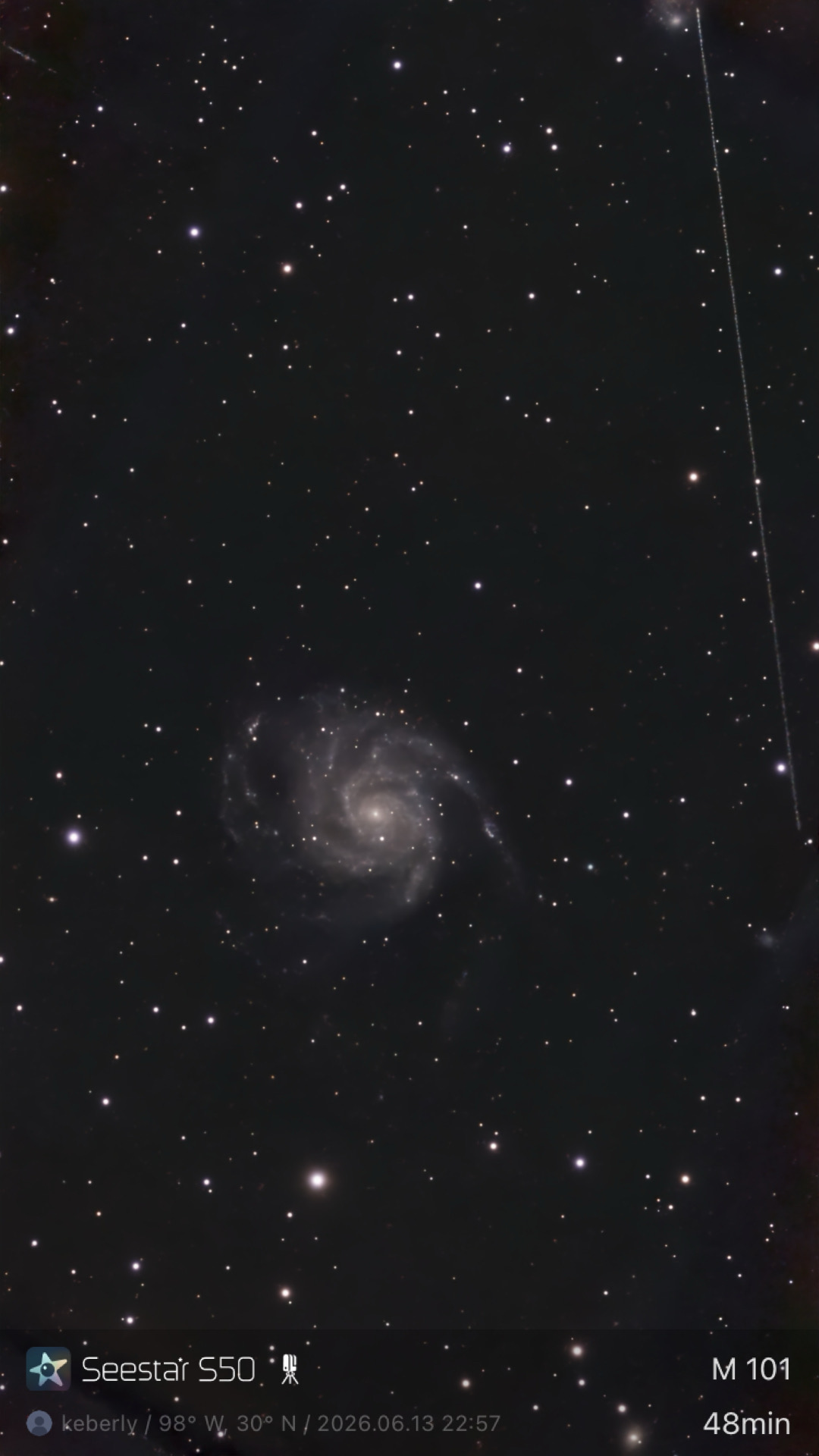
 Darth Vader (ZWO Seestar S50)
What you're looking at
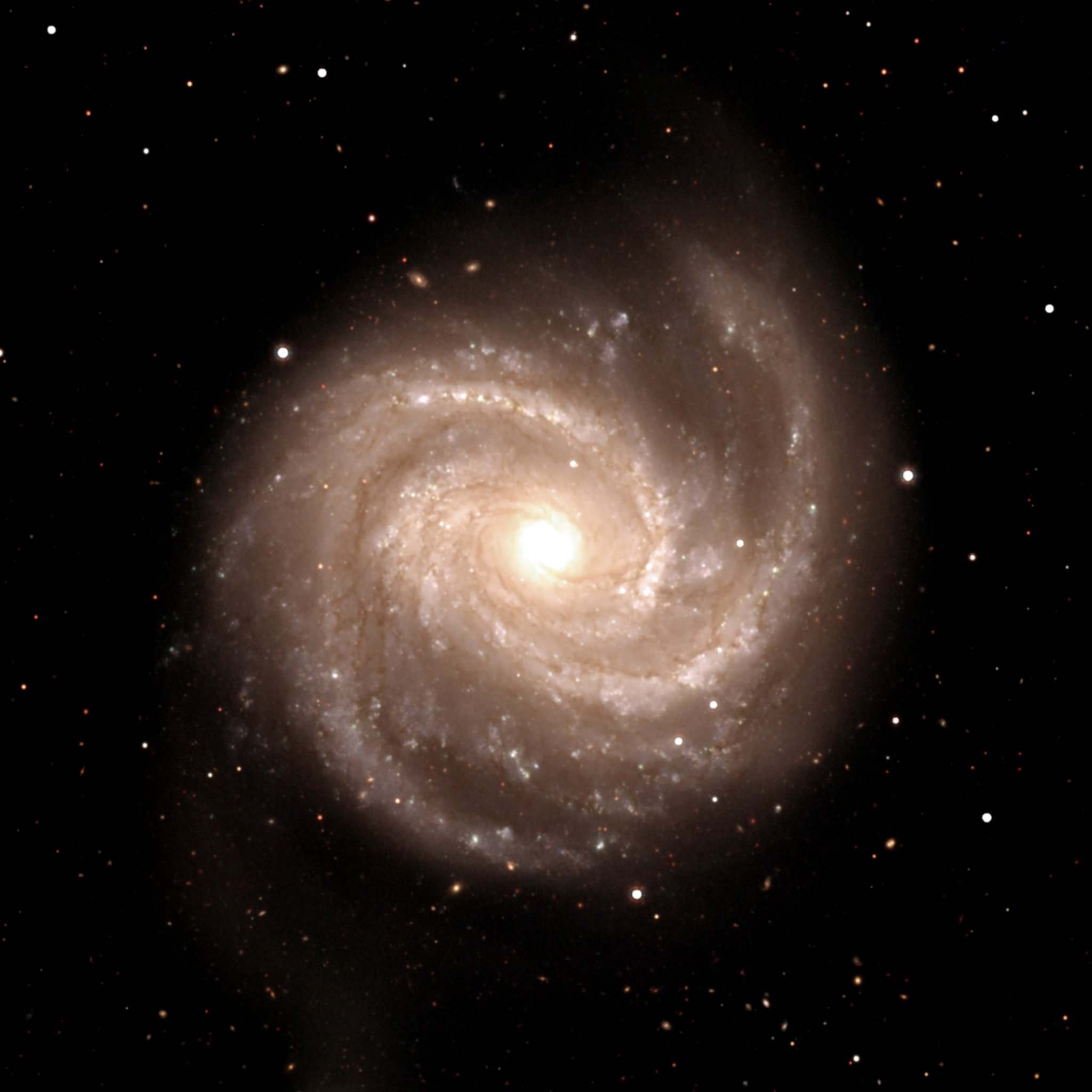
M101 is a grand-design face-on spiral galaxy about 21 million light years away in the constellation Ursa Major. It's also called the Pinwheel Galaxy for its near-perfect face-on orientation — we're looking down at it from almost directly above its disk.
At roughly 170,000 light years across, M101 is about 70% larger than the Milky Way and contains close to a trillion stars. The bright knots scattered along its spiral arms are gigantic H II regions — clouds of glowing hydrogen where new stars are actively forming at a rate that outpaces our own galaxy's.
M101 has a known asymmetry to its disk — its arms are visibly lopsided, with the brightest star-forming regions concentrated on one side. This is thought to be the lingering effect of a near-miss gravitational encounter with a smaller companion galaxy hundreds of millions of years ago. The galaxy still hasn't fully relaxed back to symmetry.
The thin streak across the upper-right corner of the frame is a satellite passing through during the capture window. It's a real-time record of how crowded low-Earth orbit has become — most multi-hour deep-sky stacks now include at least one satellite trail, and you can choose to clean them out in post or leave them in as part of the record.
The lesson
The lopsided arms aren't a flaw.
Hundreds of millions of years ago something heavy passed close enough to gravitationally yank M101's structure out of balance. The disk hasn't recovered. It probably never will, exactly — by the time it would, another encounter will reshape it again.
Most things that look stable are actually a snapshot of a long, slow recovery from the last disturbance. The shape you see is the integral of every previous shock. Including yours.
Same object, from a professional survey telescope
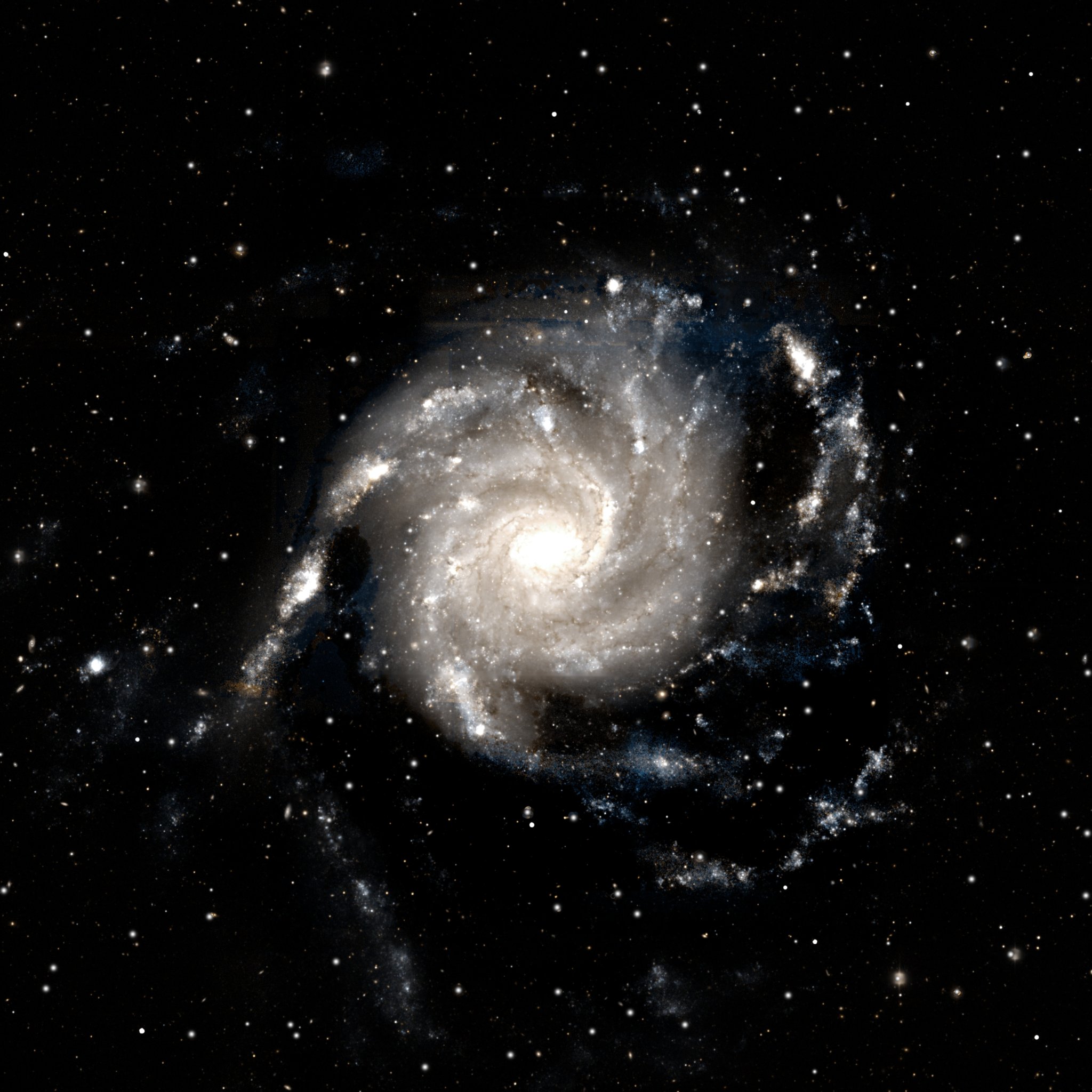
Image data: Legacy Surveys / D. Lang (Perimeter Institute); DESI Legacy Imaging Surveys / DR9 (BASS, Bok 2.3-m telescope, Steward Observatory/University of Arizona, Kitt Peak), with gap repairs from Pan-STARRS DR1 (STScI / University of Hawaii) — public archives. Reprocessed from raw survey bricks by Kyle Eberly / Sitreps.
- My telescope
- ZWO Seestar S50 — a 50 mm (2-inch) lens
- This telescope
- Bok 2.3-meter (Kitt Peak, Arizona) — roughly 2,100× more light-collecting area
- Pixel scale
- 2.4″/px (Seestar) vs 0.4″/px — about 6× finer detail
- The repair story
- Three of the nine survey data tiles were defective; a second survey (Pan-STARRS) supplied the missing floor — details in the full entry
Same object, same physics — the difference is aperture, sky, and pixel scale. This field was also the hardest repair job of the whole survey series: three of its nine data tiles were quietly defective, and the dark gap west of the core that I spent hours trying to “fix” turned out, on cross-checking against a second telescope, to be the galaxy’s real shape. The instrument buys you photons; the processing still has to earn the picture.
Same galaxy, split into its colors
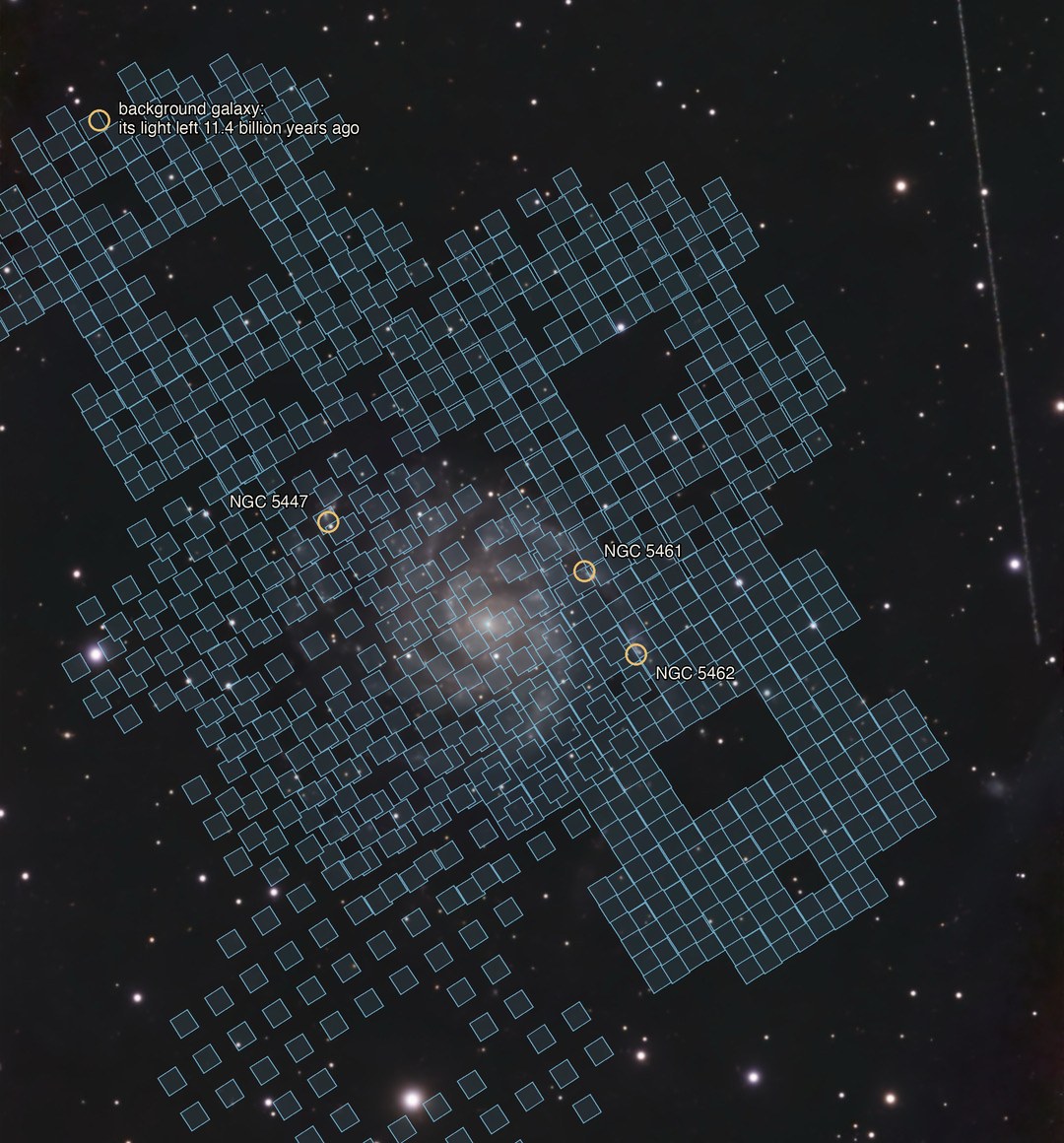
In 2020 and 2021, the Hobby-Eberly Telescope in West Texas swept its VIRUS spectrograph across M101 fourteen times during the HETDEX survey. HETDEX is a blind survey: M101 simply sits inside one of its fields. VIRUS doesn't take pictures. Each of its fiber bundles records a spectrum from 3,500 to 5,500 Å at every point it covers, and the survey's Public Data Release 1 (2026) made those spectra available to anyone. I matched my backyard frame to the sky using 144 Gaia stars (median error 0.4 arcseconds), so every square below sits where the big telescope actually looked.
![Three stacked spectra, for NGC 5461, NGC 5462 and NGC 5447, each a flat line with sharp spikes labeled [O II], [Ne III], H-delta, H-gamma, H-beta and [O III]. The [O II] spike is tallest in all three. NGC 5462 has the strongest [O III] relative to H-beta.](/images/astronomy/m101-hetdex-hii-spectra.jpg)
- The telescope
- Hobby-Eberly Telescope, McDonald Observatory — 10 m, about 25,000× the light-collecting area of my 50 mm lens
- Alignment
- 144 Gaia stars matched, 0.4″ median error (a fifth of a pixel)
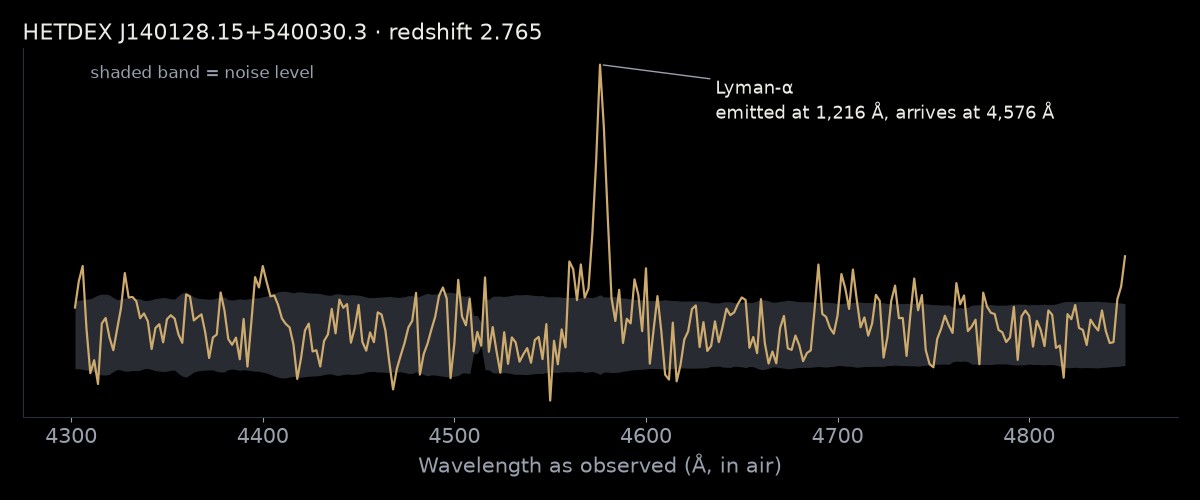
- Physics check
- [O III] 5007/4959: measured 3.00, 3.19, 3.00; atomic physics says 2.98
- Oldest light
- 11.4 billion years, from redshift 2.765 (my own fit matches the survey catalog)
Two honest caveats. HETDEX was built to map millions of distant galaxies, not nearby ones. Its pipeline flags the whole of M101 as a large foreground galaxy, and the survey team notes that its sky subtraction isn't designed for very extended nearby galaxies, so absolute brightnesses here aren't reliable. I set that galaxy-wide flag aside, avoided pixels with other quality flags, and measured 7 to 18 arcseconds from each region's catalog center, still inside these complexes, which span roughly 30 arcseconds. Then I leaned on ratios that survive those problems: the [O III] pair, whose ratio is fixed by atomic physics, and the hydrogen Balmer lines, whose ratio is set by atomic physics and can only be lowered by dust. A fourth region, NGC 5471, failed those checks, so it isn't shown.
Spectra: HETDEX Public Data Release 1 (Mentuch Cooper et al. 2026, ApJS 284, 67), the HET (Ramsey et al. 1998; Hill et al. 2021), the VIRUS instrument (Hill et al. 2021) and the HETDEX survey (Gebhardt et al. 2021). HETDEX is led by the University of Texas at Austin McDonald Observatory and Department of Astronomy with participation from the Ludwig-Maximilians-Universität München, Max-Planck-Institut für Extraterrestrische Physik (MPE), Leibniz-Institut für Astrophysik Potsdam (AIP), Texas A&M University, Pennsylvania State University, Institut für Astrophysik Göttingen, The University of Oxford, Max-Planck-Institut für Astrophysik (MPA), The University of Tokyo and Missouri University of Science and Technology. Observations for HETDEX were obtained with the Hobby-Eberly Telescope (HET), which is a joint project of the University of Texas at Austin, the Pennsylvania State University, Ludwig-Maximilians-Universität München, and Georg-August-Universität Göttingen. The HET is named in honor of its principal benefactors, William P. Hobby and Robert E. Eberly. The Visible Integral-field Replicable Unit Spectrograph (VIRUS) was used for HETDEX observations. VIRUS is a joint project of the University of Texas at Austin, Leibniz-Institut für Astrophysik Potsdam (AIP), Texas A&M University, Max-Planck-Institut für Extraterrestrische Physik (MPE), Ludwig-Maximilians-Universität München, Pennsylvania State University, Institut für Astrophysik Göttingen, University of Oxford, and the Max-Planck-Institut für Astrophysik (MPA). We acknowledge the Texas Advanced Computing Center (TACC) at The University of Texas at Austin for providing high performance computing, visualization, and storage resources that have contributed to the results reported on this page (http://www.tacc.utexas.edu). Funding for HETDEX has been provided by the partner institutions, the National Science Foundation, the State of Texas, the US Air Force, and by generous support from private individuals and foundations. Star positions: ESA Gaia DR3 (Gaia Collaboration, Vallenari et al. 2023), processed by DPAC. Spectra extracted, fitted and plotted by Kyle Eberly / Sitreps.
One photo. One lesson.
New entries land when the sky cooperates. Get them by email, plus the Sitreps jobs newsletter — no schedule, no spam. Unsubscribe from either one anytime.
Object data
- Catalog
- M101 · NGC 5457
- Constellation
- Ursa Major
- Type
- Grand-design face-on spiral galaxy (SAB(rs)cd)
- Distance
- ~21 million light-years
- Diameter
- ~170,000 light-years (≈1.7× Milky Way)
- Star count
- ~1 trillion
- Notable feature
- Asymmetric arms from past gravitational encounter
- Discovery
- 1781 · Pierre Méchain