
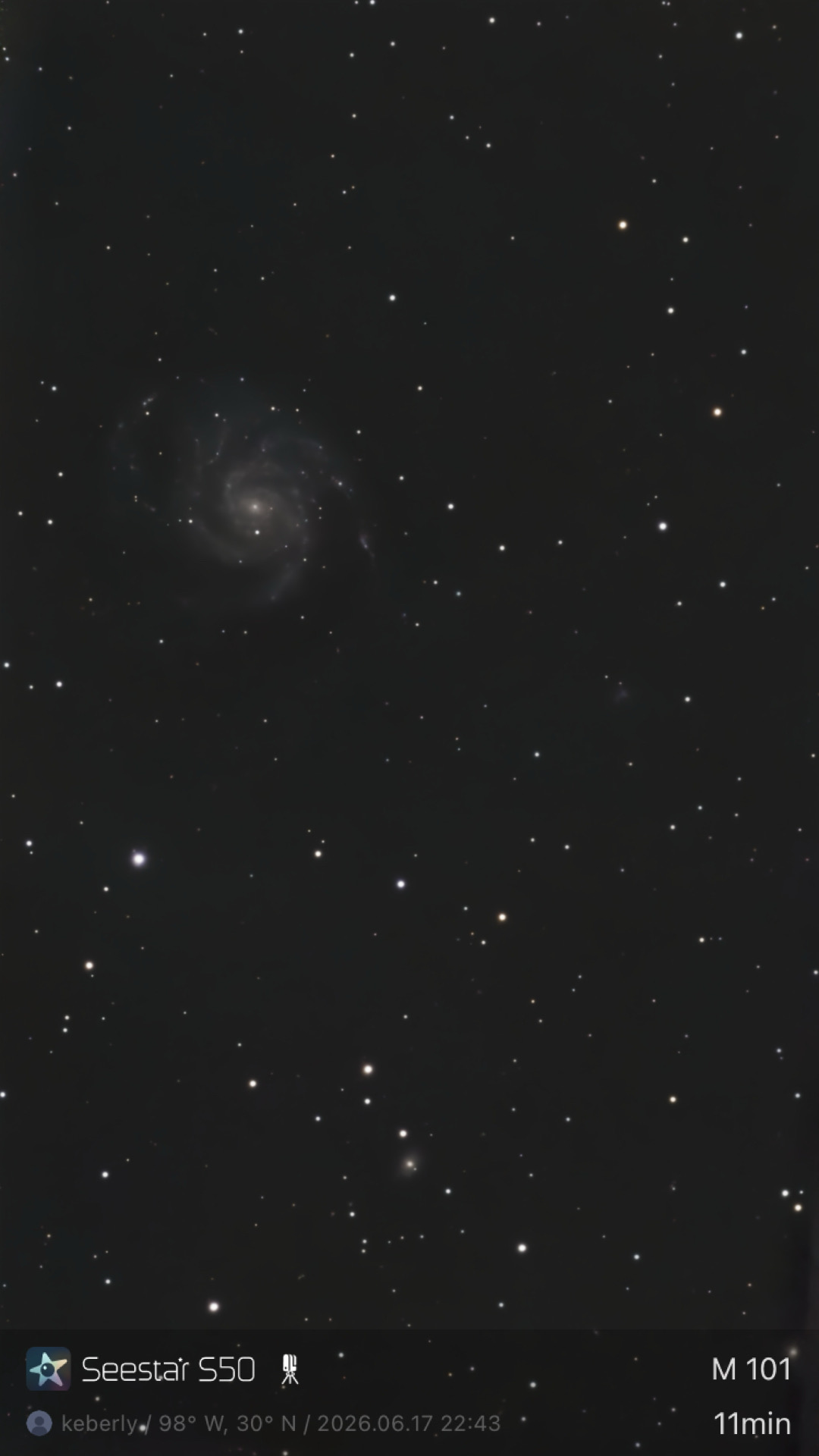
M101 — The Pinwheel, Revisited
Same target, 11 minutes, a different sky
What you're looking at
This is the same target as the existing M101 entry — the Pinwheel Galaxy, ~21 million light years away in Ursa Major, ~170,000 light years across, one trillion stars. The astrophysics didn't change. The photons that reach Earth from M101 are the same photons regardless of where on the planet you're standing.
What changed was the noise floor. From the original Lakeway capture, the sky over suburban Austin contributed roughly 10× more background photons per second than the Sea of Cortez sky over Bahía de los Ángeles. The signal from M101 has to outshine that background to be visible. From Bortle 6, you need to integrate long enough that the M101 signal builds up faster than the sky background's random fluctuations. From Bortle 2, the background is already so low that M101's signal dominates almost immediately.
The math: signal-to-noise scales with the square root of integration time, and inversely with the square root of sky background. Reducing sky background by 10× is equivalent to increasing integration time by ~10× in the original sky. So 11 minutes from Bortle 2 ≈ 110 minutes from Bortle 6. The Lakeway capture was 48 minutes. The Baja capture was 11. The Baja capture has more visible detail.
The lesson
The gear was identical. The hands were the same. The only variable was where I was standing.
The original M101 entry in this gallery is a 48-minute stack from a backyard in suburban Texas. This entry is an 11-minute stack from the Sea of Cortez. Same telescope. Same software. Same person. The dark-sky version is the better image.
Most things you try to optimize in your life are integration time. Sometimes the lever is sky background instead.
Object data
- Catalog
- M101 · NGC 5457
- Constellation
- Ursa Major
- Type
- Grand-design face-on spiral galaxy
- Distance
- ~21 million light-years
- Diameter
- ~170,000 light-years (≈1.7× Milky Way)
- Integration
- 11 minutes (vs. 48 minutes for the Lakeway version)
- Sky
- Bortle 2 (vs. Bortle 6 for the Lakeway version)
- Effective integration-equivalent
- ~110 minutes if shot from Lakeway
- Companion entry
- /astronomy/m101 — the original Bortle 6 capture, for comparison