

M104 — The Sombrero Galaxy
An edge-on spiral with a dust lane, 29 million light years away
What you're looking at
M104 is a spiral galaxy seen nearly edge-on from Earth, about 29 million light years away in the constellation Virgo. The dark band slicing across the bright central bulge is a dense ring of cosmic dust in the galaxy's disk, silhouetted against the glowing core behind it. That dust lane gives the galaxy its nickname — the Sombrero.
What makes M104 unusual is its enormous central bulge: a near-spherical cloud of stars and gas that holds a supermassive black hole at its core — one of the largest known to amateur astronomers, with a mass roughly 1 billion times that of the Sun. The black hole is at the geometric center of the bright bulge in this image.
Despite its small angular size in the Seestar's wide field, the galaxy reads unmistakably as an edge-on disk with the dust lane visible — even at just 6 minutes of integration. With a longer stack, the dust structure resolves into ribbons and clumps.
The lesson
Sometimes the shape gives away the structure faster than any amount of detail would.
Six minutes of light wasn't enough to resolve the dust lane's individual ribbons. But it was enough to see the *shape* — a flat disk, a bulge, a line across the middle. That alone is enough to know exactly what you're looking at: a spiral galaxy edge-on, with a billion-solar-mass black hole sitting inside the bright spot.
The first impression carries more information than people give it credit for.
Same object, from a 4-meter survey telescope
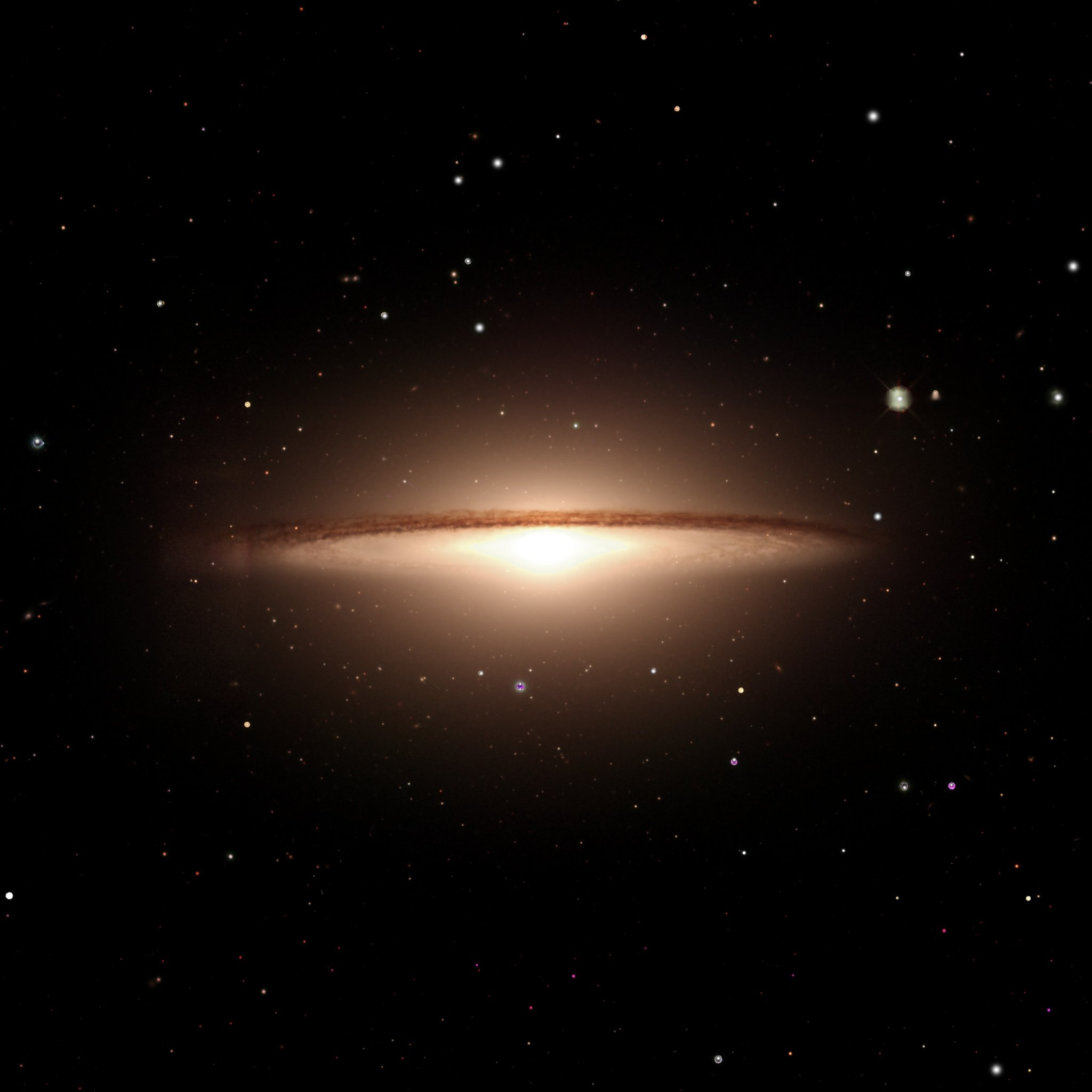
Image data: Legacy Surveys / D. Lang (Perimeter Institute); DESI Legacy Imaging Surveys / DR10 (DECam, built by the Dark Energy Survey collaboration, on the Víctor M. Blanco 4-m telescope, CTIO/NOIRLab/NSF/AURA) — public archive. Reprocessed from raw survey bricks by Kyle Eberly / Sitreps.
- My telescope
- ZWO Seestar S50 — a 50 mm (2-inch) lens
- This telescope
- Víctor M. Blanco 4-meter (DECam, Chile) — roughly 6,400× more light-collecting area
- Pixel scale
- 2.4″/px (Seestar) vs 0.262″/px (DECam) — about 9× finer detail
- The data
- Raw survey “bricks” from the public DESI Legacy Surveys archive, stitched and processed with my own pipeline
Same object, same physics — the difference is aperture, sky, and pixel scale. This telescope sits on a Chilean mountaintop with a mirror thousands of times the area of my lens. The part that surprised me: its raw data needs the same work mine does — sky gradients, stitching, color balance — and both versions came out of the same Python pipeline. The instrument buys you photons; the processing still has to earn the picture.
One photo. One lesson.
New entries land when the sky cooperates. Get them by email, plus the Sitreps jobs newsletter — no schedule, no spam. Unsubscribe from either one anytime.
Object data
- Catalog
- M104 · NGC 4594
- Constellation
- Virgo
- Type
- Edge-on spiral / lenticular hybrid
- Distance
- ~29 million light-years
- Diameter
- ~50,000 light-years
- Central black hole
- ~1 billion solar masses
- Notable feature
- Prominent dust lane silhouetted against bulge
- Discovery
- 1781 · Pierre Méchain