M13 — The Hercules Globular Cluster
300,000 stars in a 22,200-light-year ball, older than the Earth
 Darth Vader (ZWO Seestar S50)
What you're looking at
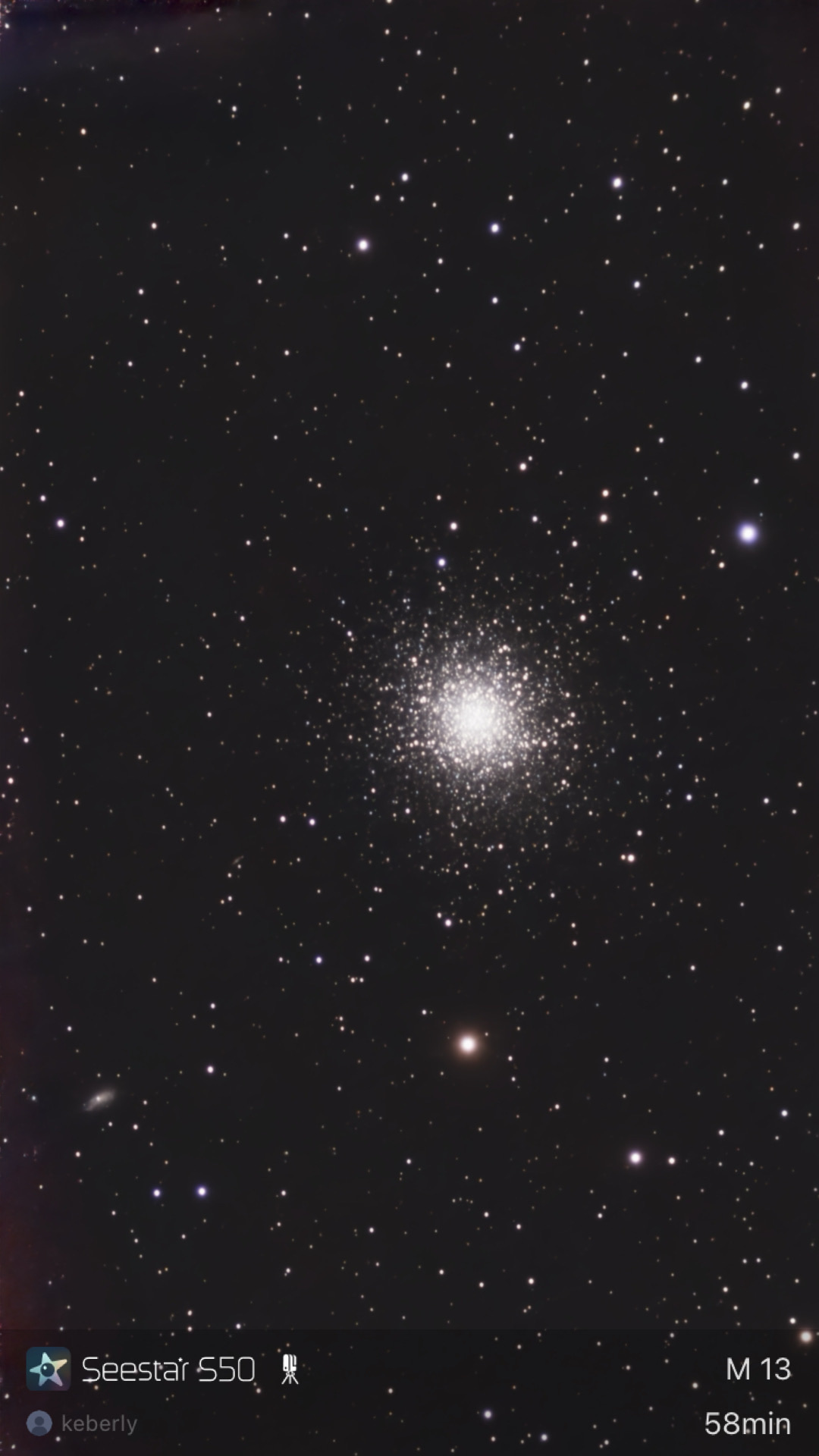
M13 is the brightest globular cluster in the northern sky and one of the closest, at 22,200 light years from Earth. It contains roughly 300,000 stars bound together by their own gravity into a ball about 145 light years across.
The stars in M13 are among the oldest in the Milky Way — about 11.65 billion years old, which makes them more than two and a half times older than the Earth and the Sun. They predate the formation of the galactic disk itself. The Milky Way as we know it was built around clusters like this.
The faint elongated smudge in the lower-left corner of the frame is NGC 6207, a small spiral galaxy about 30 million light years away — over a thousand times farther than M13 itself. Two completely different scales of object captured in the same image: a tight knot of stars inside our own galaxy, and a separate galaxy in the deep background.
The lesson
Everything in this image is older than the planet you're standing on.
M13 is what the Milky Way used to be — a loose collection of dense, ancient star clusters that eventually settled into the disk we live in today. The galactic spiral, the solar system, all of it was built on top of the structure these clusters laid down.
It's the slowest possible reminder that the things that look like backdrops are usually the foundation.
One photo. One lesson.
New entries land when the sky cooperates. Get them by email, plus the Sitreps jobs newsletter — no schedule, no spam. Unsubscribe from either one anytime.
Object data
- Catalog
- M13 · NGC 6205
- Constellation
- Hercules
- Type
- Globular cluster
- Distance
- ~22,200 light-years
- Diameter
- ~145 light-years
- Star count
- ~300,000
- Age
- ~11.65 billion years
- Background object
- NGC 6207 (faint spiral, lower-left)
- Discovery
- 1714 · Edmond Halley