M17 — The Omega (Swan) Nebula
A bright emission nebula in Sagittarius, 5,500 light years away
What you're looking at
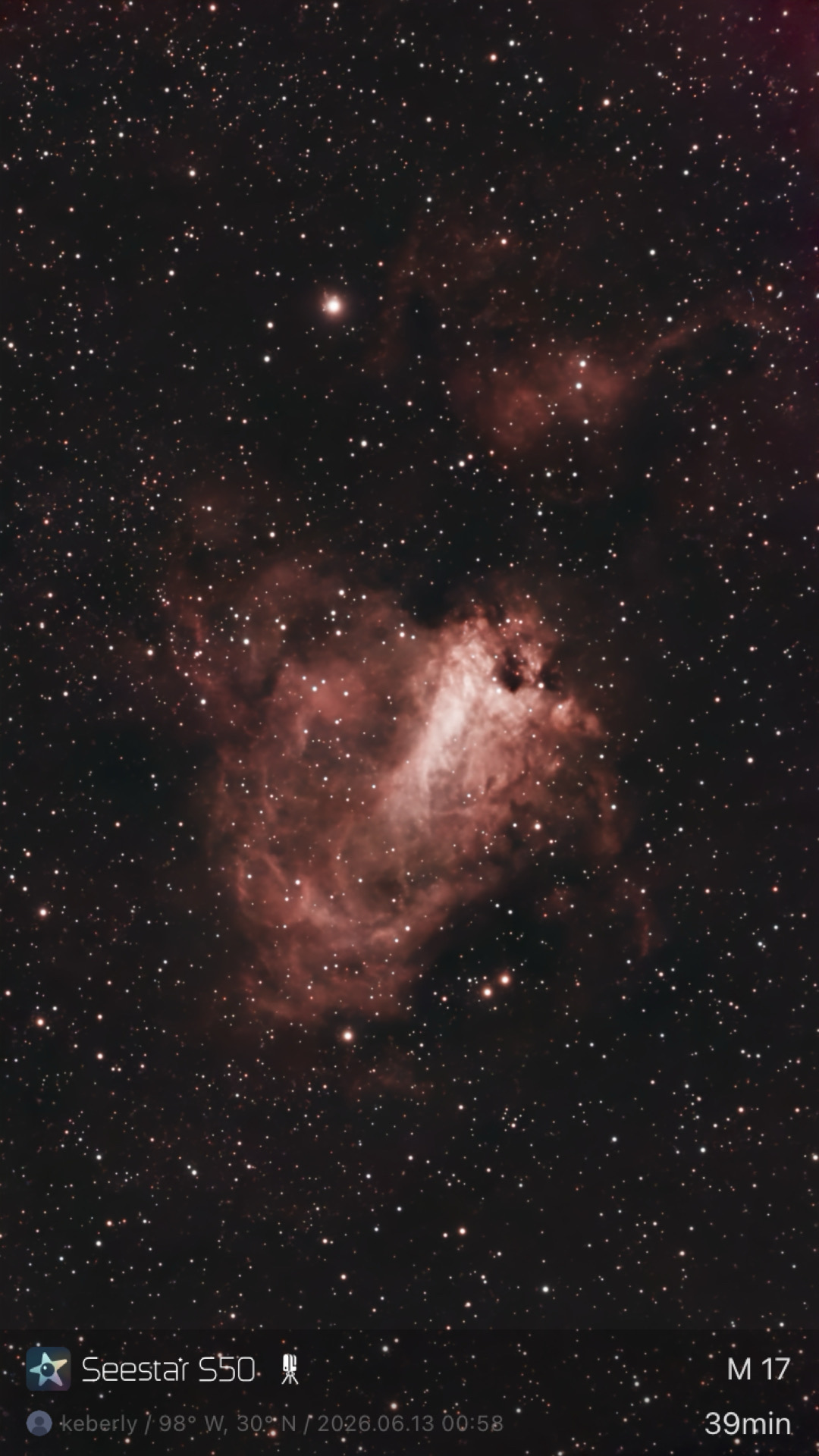
M17 is one of the brightest and most massive star-forming regions in the Milky Way — about 5,500 light years away in Sagittarius, with an estimated mass of 30,000 suns of glowing hydrogen.
The shape that gives it its names — the Greek letter Omega, or a swan — comes from a single dense bar of glowing gas illuminated by a hidden young open cluster (NGC 6618). The “swan's body” is the bar; the hook at the top is foreground gas catching the cluster's light.
M17 is rich in O- and B-class stars: the hottest, most short-lived stars in the galaxy. The radiation from those stars is what makes the nebula glow — and is also what's slowly tearing it apart. Within a few million years M17 will burn through the gas that birthed it.
The lesson
We don't name what we see, we name what we recognize.
M17 isn't an omega and it isn't a swan. It's a chaotic cloud of ionized hydrogen with a brutal young star cluster eating it from the inside. But your brain pattern-matches it to something familiar within a second of seeing it, and the name sticks.
Career transitions work the same way. People will pattern-match your experience to whatever shape is closest to one they already recognize. Your job isn't to explain the actual physics — it's to give them a clean shape they can hold on to.
One photo. One lesson.
New entries land when the sky cooperates. Get them by email, plus the Sitreps jobs newsletter — no schedule, no spam. Unsubscribe from either one anytime.
Object data
- Catalog
- M17 · NGC 6618
- Common names
- Omega · Swan · Horseshoe · Lobster
- Constellation
- Sagittarius
- Type
- Emission nebula · H II region
- Distance
- ~5,500 light-years
- Mass
- ~30,000 solar masses of gas
- Embedded cluster
- NGC 6618 (~800 stars)
- Discovery
- 1745 · Philippe Loys de Chéseaux