M20 — The Trifid Nebula
Three kinds of nebula in one frame, 5,200 light years away
What you're looking at
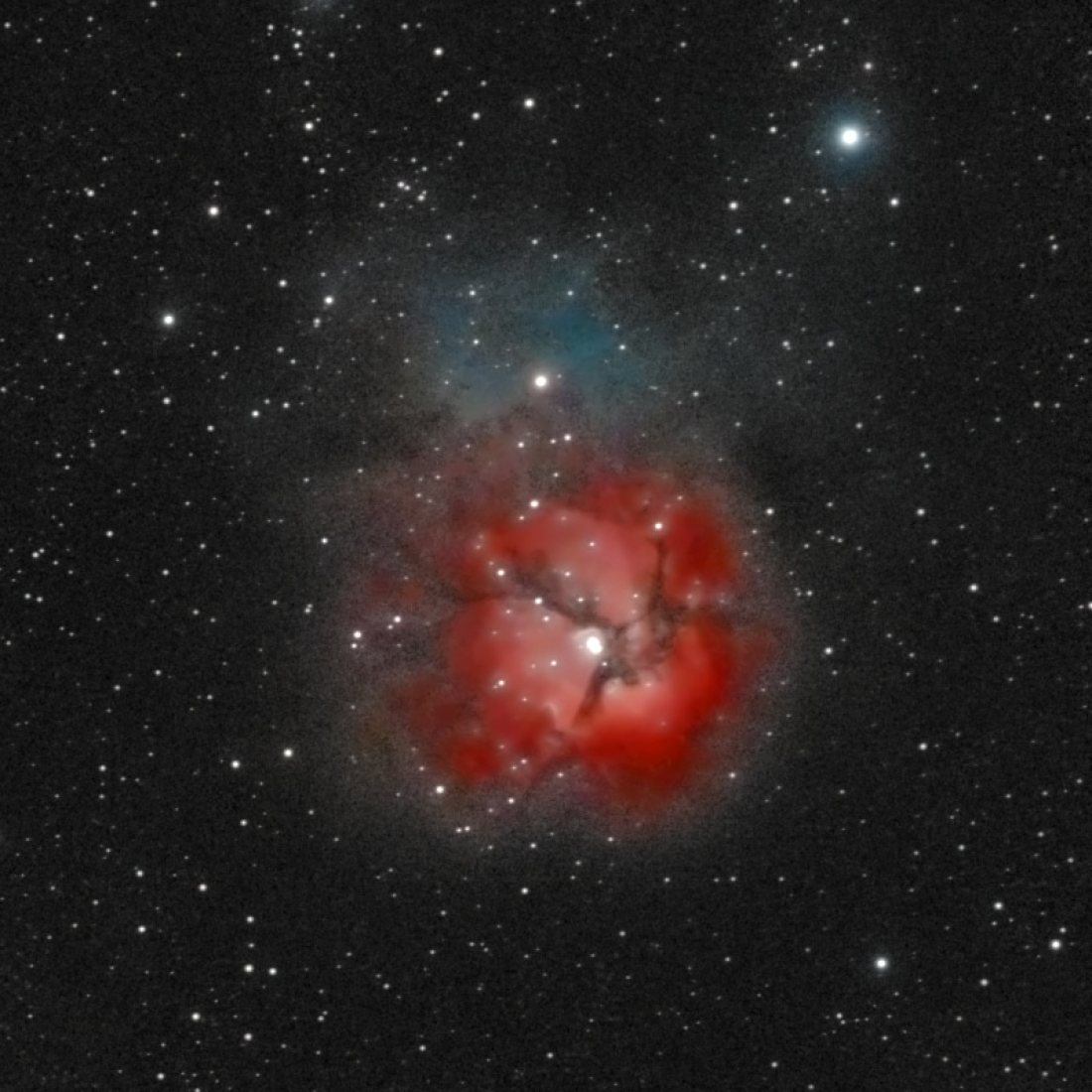
M20 sits about 5,200 light years away in Sagittarius. It is one of the rare objects in the sky that contains three distinct kinds of nebula in a single frame: an emission nebula (the pink central glow), a reflection nebula (the blue gas surrounding it, scattering starlight), and a dark nebula (the trio of dust lanes that divide the pink lobe into three pieces, giving the Trifid its name).
The bright star at the center of the pink lobe is HD 164492 — a young, hot O-class star whose ultraviolet radiation ionizes the surrounding hydrogen and makes it glow.
The open cluster visible in the upper-left corner of this image is M21, an unrelated young star cluster about 4,250 light years away. The two are often imaged together because they sit close on the sky.
The lesson
Three kinds of light coming from the same object at the same time.
Pink (emission): hydrogen excited by a young star until it glows on its own. Blue (reflection): dust passively scattering someone else's light. Dark (absorption): material so dense it blocks light from reaching you at all.
All three are doing different work for the same nebula. None of them is wrong. None of them is the “real” one. The picture only makes sense when you allow that an object can be all three at once.
One photo. One lesson.
New entries land when the sky cooperates. Get them by email, plus the Sitreps jobs newsletter — no schedule, no spam. Unsubscribe from either one anytime.
Object data
- Catalog
- M20 · NGC 6514
- Constellation
- Sagittarius
- Type
- Emission + reflection + dark nebula
- Distance
- ~5,200 light-years
- Diameter
- ~42 light-years
- Central star
- HD 164492 (O-class)
- Adjacent cluster
- M21 (visible upper-left)
- Discovery
- 1764 · Charles Messier