
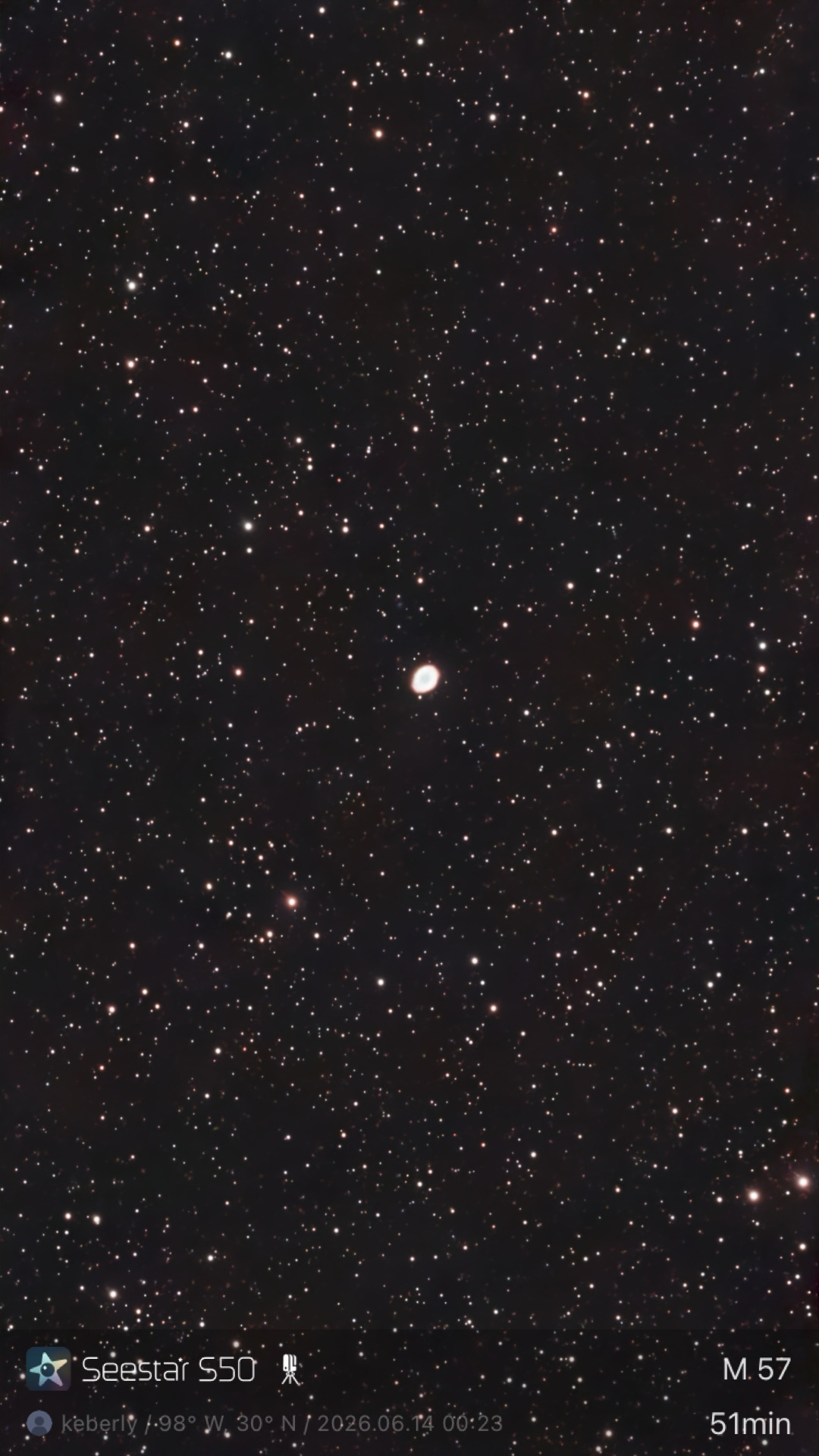
M57 — The Ring Nebula
A perfect smoke ring around a dying star, 2,300 light years away
What you're looking at
M57 is one of the most famous planetary nebulae in the sky — a near-perfect smoke ring of ionized gas about 2,300 light years away in the constellation Lyra. It's small (only 1.3 arcminutes across, less than 5% the apparent size of the moon) but its surface brightness is high enough to see in modest backyard telescopes.
At the center of the ring is a white dwarf — the exposed core of a dying Sun-like star that shed its outer layers about 20,000 years ago. The ring is that shed material, now expanding outward at roughly 30 kilometers per second. The white dwarf is around magnitude 15.8 — at the very edge of what the Seestar can detect.
The shape isn't actually a ring. The Ring Nebula is a barrel-shaped or torus structure that happens to be oriented nearly end-on to our line of sight, so we see through the thin walls of the barrel. From a different angle in space, it would look like a glowing cigar.
Paired with M27 (the Dumbbell), this is a complete view of what's coming for our own Sun. Both are Sun-like stars at the end of their lives. In about 5 billion years, the Solar System will look like one of these images from somewhere else in the galaxy.
The lesson
What looks like a ring is a barrel seen end-on.
The Ring Nebula is one of the most-photographed objects in the sky, and the image everyone recognizes — that perfect oval — is a coincidence of viewing angle. Rotate the same object 90° in space and it would look like a glowing cigar. Different observer, different shape, same physical thing.
Most of what you think you know about a situation is conditional on where you're standing. Move your perspective and the shape changes; the object hasn't.
Object data
- Catalog
- M57 · NGC 6720
- Constellation
- Lyra
- Type
- Planetary nebula (bipolar / torus, viewed end-on)
- Distance
- ~2,300 light-years
- Diameter
- ~1.3 light-years
- Age
- ~20,000 years (since the central star shed its outer layers)
- Central object
- White dwarf · magnitude ~15.8
- Expansion rate
- ~30 km/sec
- Discovery
- 1779 · Antoine Darquier de Pellepoix