M8 — The Lagoon Nebula
A stellar nursery in Sagittarius, 5,000 light years away
What you're looking at
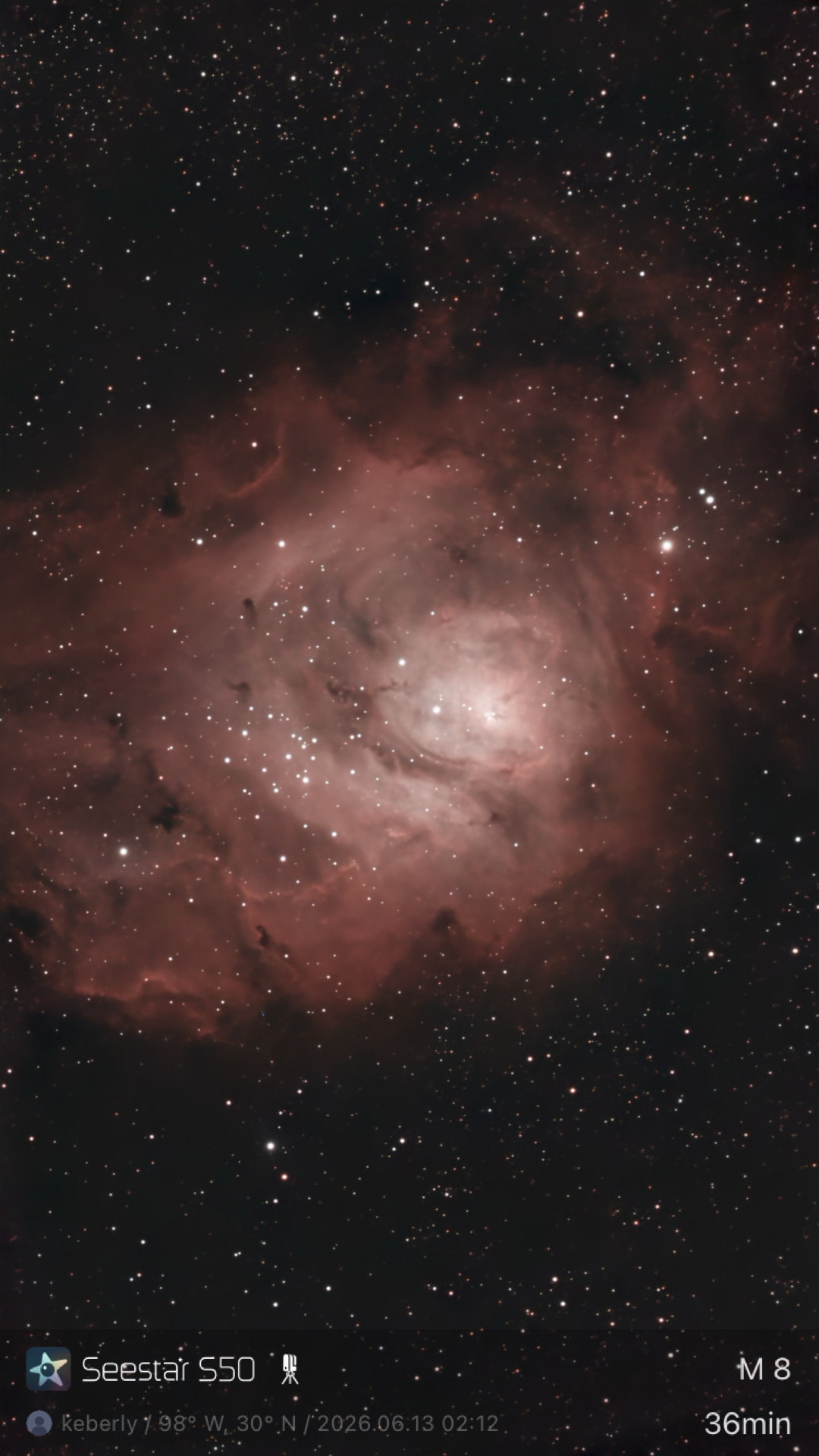
M8 is one of the only emission nebulae visible to the naked eye from Earth, sitting about 5,000 light years away in the constellation Sagittarius. It's roughly 100 light years across — a vast, ongoing star factory powered by a young open cluster (NGC 6530) embedded in the gas.
The bright knot near the center of the frame is the Hourglass Nebula — a smaller sub-region where star formation is happening *right now*, illuminated by a single massive star, Herschel 36. The dark dust lanes that give the nebula its name are sites where the gas is dense enough to collapse into new stars.
From 30° N latitude in Texas, M8 climbs high enough in summer to image cleanly through Bortle 6 light pollution — something photographers in the northern half of the country can't easily do.
The lesson
Where transformation actually happens isn't always pretty up close.
The bright Hourglass core at the center of M8 is where new stars are being born. It's also the busiest, most chaotic part of the whole nebula — dense gas, brutal radiation pressure, dust lanes collapsing into themselves under their own weight.
Most veteran transitions look like the rest of the nebula: diffuse, broad, slow. The part that actually changes you is small, intense, and uncomfortable. Identify it, sit in it, let it run.
One photo. One lesson.
New entries land when the sky cooperates. Get them by email, plus the Sitreps jobs newsletter — no schedule, no spam. Unsubscribe from either one anytime.
Object data
- Catalog
- M8 · NGC 6523
- Constellation
- Sagittarius
- Type
- Emission nebula · H II region
- Distance
- ~5,000 light-years
- Diameter
- ~110 light-years
- Sub-region
- Hourglass Nebula (central core)
- Embedded cluster
- NGC 6530
- Discovery
- 1747 · Le Gentil