M92 — The Other Hercules Globular
Among the oldest objects in the universe, 26,700 light years away
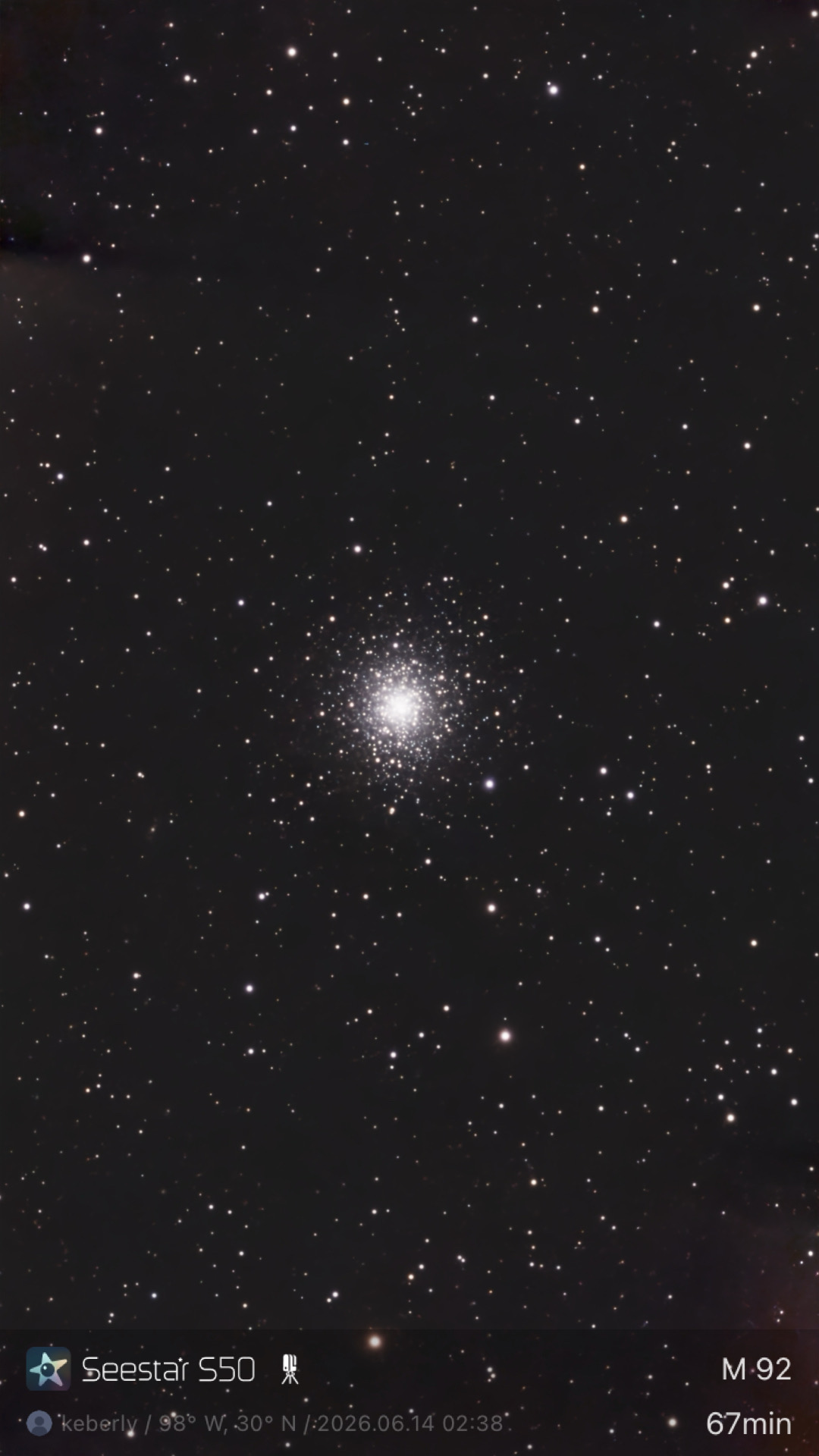
 Darth Vader (ZWO Seestar S50)
What you're looking at
M92 is the other major globular cluster in the constellation Hercules — perpetually overshadowed by its more famous neighbor M13, which sits about 9° away. At magnitude 6.3 it's actually visible to the naked eye under dark skies, and is one of the brightest globulars in the northern sky.
Despite its lower profile, M92 has a claim that M13 doesn't: it may be the oldest object in the Milky Way that we can image easily from Earth. Age estimates from main-sequence turnoff measurements put it at roughly 13 billion years — only ~700 million years younger than the universe itself. The stars in this image were already old when our Sun was just a cloud of gas.
M92 is also unusually metal-poor, meaning it formed from gas that hadn't yet been enriched by previous generations of supernovae. This is part of what dates it so far back: by the time the Milky Way had built up appreciable heavy elements, clusters like M92 had already finished forming. The bright concentrated core here contains stars that have outlived nearly every other star in our galaxy.
The lesson
M92 has been there the whole time.
It sits 9° from M13 in the same constellation, is naked-eye visible from dark skies, and may actually be older than the more famous cluster everyone photographs. But M13 has the brighter brand, so M92 is the one people skip.
Worth photographing the runner-up sometimes. Sometimes the runner-up is the older story.
One photo. One lesson.
New entries land when the sky cooperates. Get them by email, plus the Sitreps jobs newsletter — no schedule, no spam. Unsubscribe from either one anytime.
Object data
- Catalog
- M92 · NGC 6341
- Constellation
- Hercules
- Type
- Globular cluster (densely concentrated, class IV)
- Distance
- ~26,700 light-years
- Diameter
- ~109 light-years
- Age
- ~13 billion years (among the oldest in the Milky Way)
- Metallicity
- Very metal-poor — formed before chemical enrichment of the galaxy
- Discovery
- 1777 · Johann Elert Bode