
The First Month
Seven targets, forty minutes, no idea what I was doing
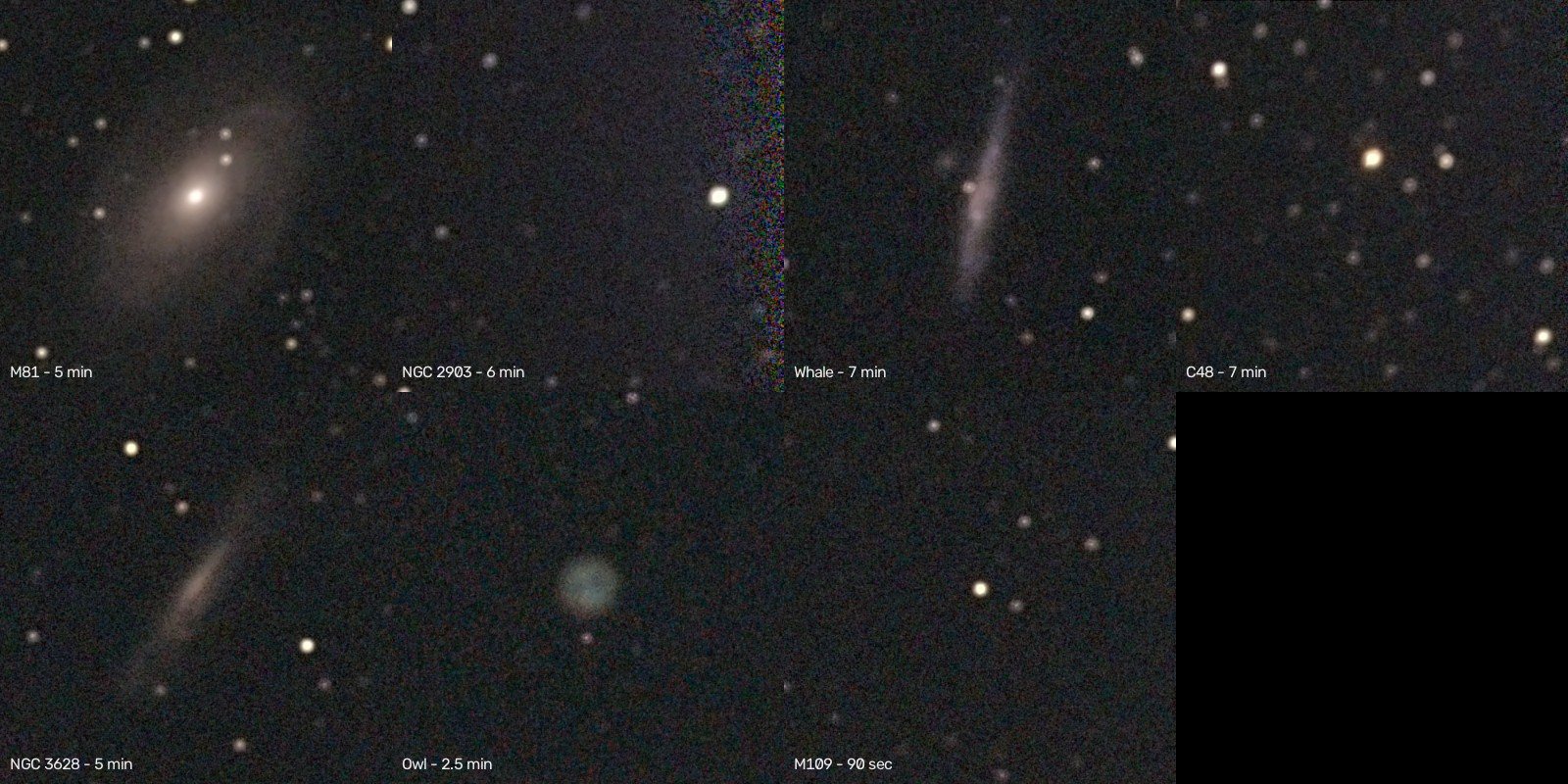
What you're looking at
This is what deep-sky imaging looks like before you understand the only rule that matters: light is a budget. Every one of these seven targets got between 90 seconds and 7 minutes of exposure — I pointed the telescope, saw a smudge appear, got impatient, and moved to the next thing. M109 got nine frames. Nine.
The physics I didn't know yet: signal grows linearly with time while noise grows as its square root, so an image gets cleaner as the square root of how long you stay. Five minutes versus three hours isn't a 36x difference in quality — but it is the difference between a rumor and a photograph. Every object on this sheet is real, correctly framed, and completely starved.
The same telescope, the same backyard, and the same sky later produced everything else in this journal — including a galaxy group 290 million light years away. Nothing about the equipment changed.
The lesson
Every image on this sheet is me being bad at something I'm now decent at, and I almost deleted them.
The instinct is to hide the early reps — the nine-frame M109, the 90-second galaxy that shows nothing. But the sheet is the only honest 'before' picture I'll ever have, and without it the rest of this page reads like talent instead of what it actually was: staying on target longer, night after night.
Veterans starting over in a civilian career are on frame one of their own sheet. The smudge isn't failure. It's underexposure. Stay on target.
Object data
- Targets attempted
- M81 · NGC 2903 · NGC 4631 · C48 · NGC 3628 · M97 · M109
- Total integration
- ~40 minutes across all seven
- Shortest attempt
- M109 — 90 seconds
- Keepers produced
- Zero
- What changed since
- Not the telescope
One photo. One lesson.
New entries land when the sky cooperates. Get them by email — no schedule, no spam, just what the telescope caught and what it taught.