
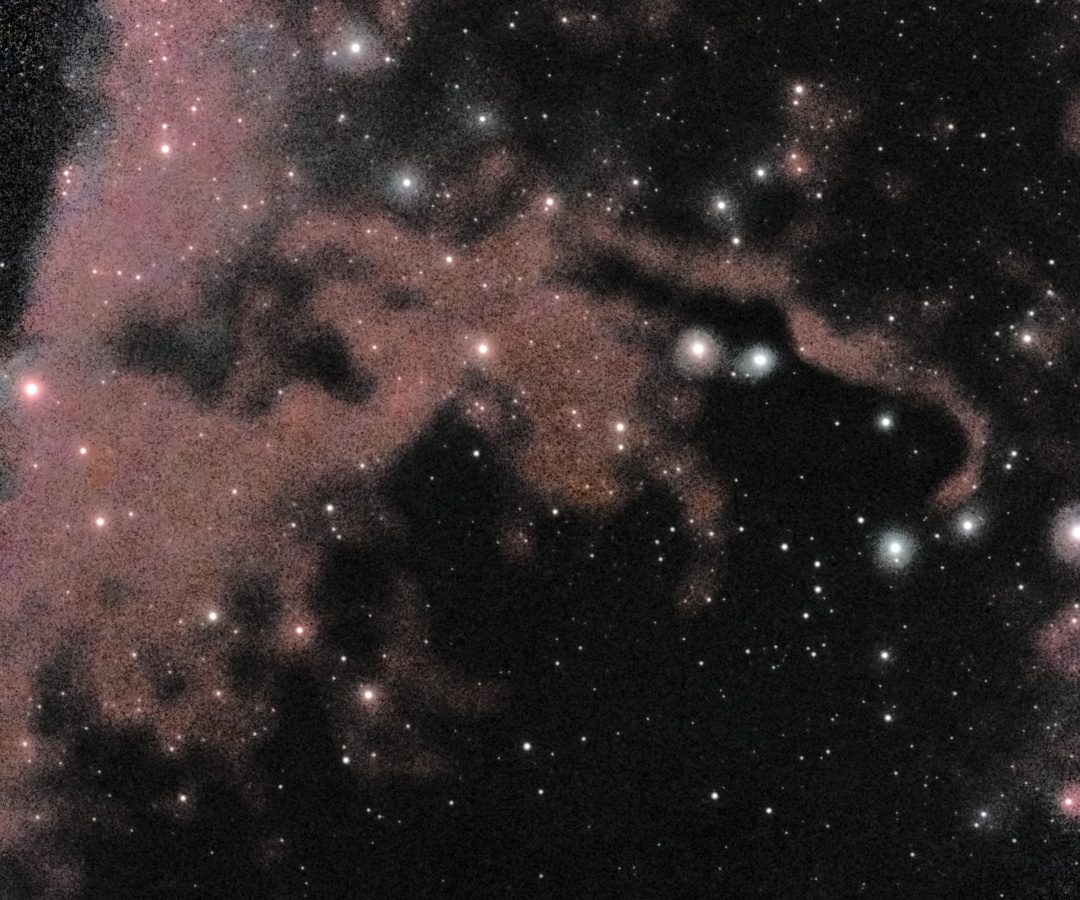
IC 1396A — The Elephant's Trunk
A dark globule 20 light-years long, 2,400 light years away
What you're looking at
The Elephant's Trunk is a rope of dark, dense gas twenty light-years long, hanging inside the vast IC 1396 emission complex in Cepheus. The trunk is a globule — a cloud dense enough to resist the radiation of the giant star that illuminates the region, while everything less dense around it gets blown away and lit up.
The bright rim tracing the trunk's edge is the side facing the star: a surface being simultaneously eroded and compressed. Inside the trunk's head, that compression has already triggered the birth of new stars — infrared surveys show a small cluster of protostars less than 100,000 years old embedded in the dark gas.
The salmon glow behind it is pure hydrogen-alpha emission — one exact wavelength of red, 656.28 nanometers, the same photon every excited hydrogen atom in the universe emits. IC 1396 as a whole spans three degrees of sky — six full moons wide — making the trunk a small detail of a structure far too large for any single telescope frame.
The lesson
The first night on this target produced nothing, and it looked identical to a good night from the ground.
Same target, same settings, same apparent sky — but a photometric check showed the atmosphere was quietly eating more than half the light. The forecast said clear. The data said otherwise. Only one of them was right.
Conditions can look fine and be hostile. Measure the environment before you grind in it — effort spent in bad conditions doesn't accumulate, it evaporates.
Object data
- Catalog
- IC 1396A (within IC 1396)
- Constellation
- Cepheus
- Type
- Dark globule with bright ionization rim
- Distance
- ~2,400 light-years
- Trunk length
- ~20 light-years
- Hidden inside
- Protostars younger than 100,000 years
- Parent complex
- IC 1396 — spans ~3° of sky (six full moons)