
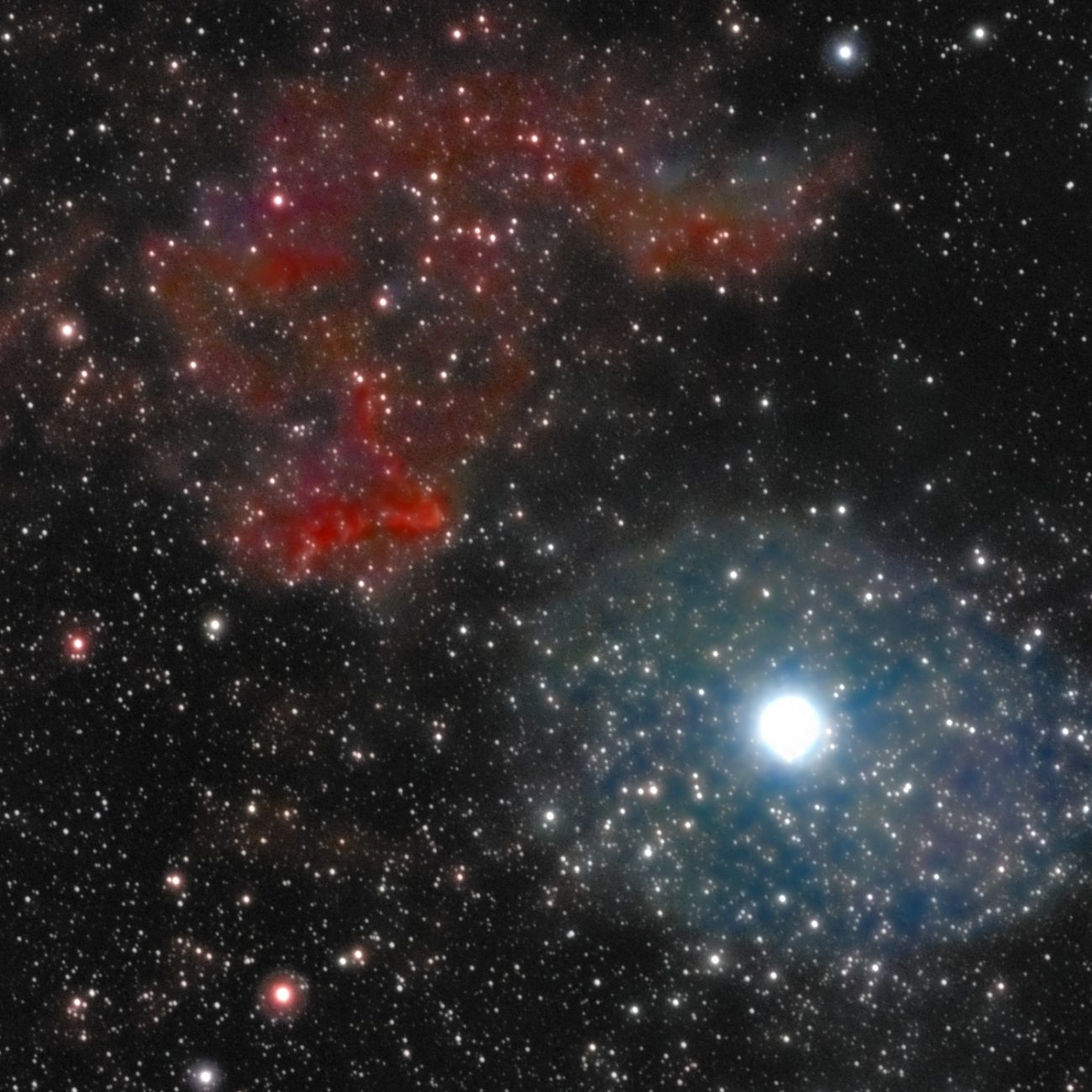
IC 63 — The Ghost of Cassiopeia
A nebula being destroyed by the star that lights it, 550 light years away
What you're looking at
IC 63 glows because it is dying. The brilliant star just out of its reach, Gamma Cassiopeiae, is 70,000 times more luminous than the Sun, and its ultraviolet radiation is simultaneously making this cloud glow and boiling it away — the nebula is evaporating under the light that reveals it.
The physics is written in the color. Where the radiation is fierce enough to strip electrons from hydrogen, the gas glows red (Hα emission). Where it only scatters off dust, the cloud shines blue (reflection). IC 63 shows both at once — a boundary between two ways of being lit, drawn across a single dissolving cloud.
Everything here sits about 550 light years away. Gamma Cas is itself unstable — a fast-spinning variable star that periodically throws off its own material. The ghost and the thing haunting it are both temporary.
The lesson
The same star that makes this nebula visible is the one destroying it.
There's no version of IC 63 that glows but survives — the radiation that lights it is the radiation that evaporates it. Illumination and consumption are the same process here, pointed the same direction.
Some sources of energy are exactly like this: the thing giving you visibility is spending you to do it. Worth knowing which of your lights are also burning you down, and choosing them on purpose.
Object data
- Catalog
- IC 63 (with IC 59)
- Constellation
- Cassiopeia
- Type
- Emission + reflection nebula
- Distance
- ~550 light-years
- Illuminating star
- Gamma Cassiopeiae — ~70,000× the Sun's luminosity
- Fate
- Evaporating under the radiation that lights it
- Integration
- 177 minutes — deepest stack in this journal
One photo. One lesson.
New entries land when the sky cooperates. Get them by email — no schedule, no spam, just what the telescope caught and what it taught.