
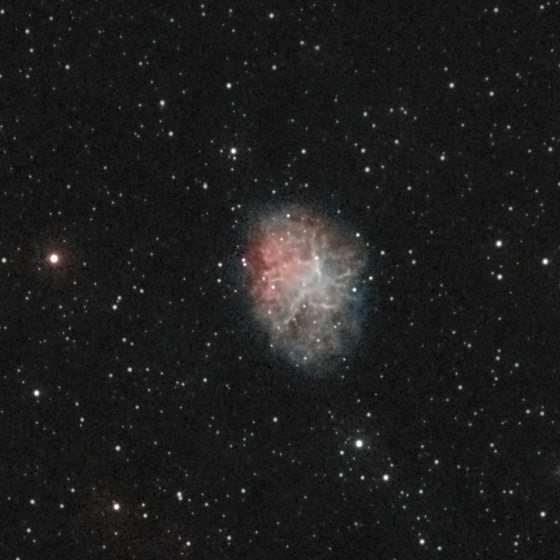
M1 — The Crab Nebula
A supernova the Earth watched happen, in the year 1054
What you're looking at
On July 4, 1054, a new star appeared in Taurus — bright enough to see in daylight for three weeks. Chinese astronomers recorded it; so, likely, did the people who left it in rock art across the American Southwest. What they saw was a massive star exploding. The Crab Nebula is the debris, still expanding nearly a thousand years later.
This is the other supernova remnant in this journal — the Veil Nebula is the 10,000-year-old version; the Crab is the 971-year-old version, caught much earlier in the same process. The reddish filaments are shredded gas; the eerie bluish interior glow is something stranger — light emitted by electrons spiraling at near light-speed through a magnetic field.
What drives it sits dead center: a pulsar, the crushed core of the dead star, a city-sized ball of neutrons spinning 30 times per second, sweeping the whole nebula with its energy. It is one of the few objects where you can point a backyard telescope at a date in recorded history.
The lesson
People wrote this down in 1054, saw it as an omen, and moved on. It was a star dying and a stranger object being born.
The supernova was the loud part — the headline event everyone recorded. The thing that actually lasted was the quiet machine left at the center, spinning in the dark, powering the whole structure for a thousand years and counting.
The explosion gets written in the chronicles. The engine it leaves behind is what does the work. Build for the engine.
Object data
- Catalog
- M1 · NGC 1952
- Constellation
- Taurus
- Type
- Supernova remnant
- Supernova seen
- July 4, 1054 AD (visible in daylight ~3 weeks)
- Distance
- ~6,500 light-years
- Central object
- A pulsar spinning ~30 times per second
- Companion remnant in this journal
- /astronomy/veil-nebula-east (10,000 years old)
One photo. One lesson.
New entries land when the sky cooperates. Get them by email — no schedule, no spam, just what the telescope caught and what it taught.