
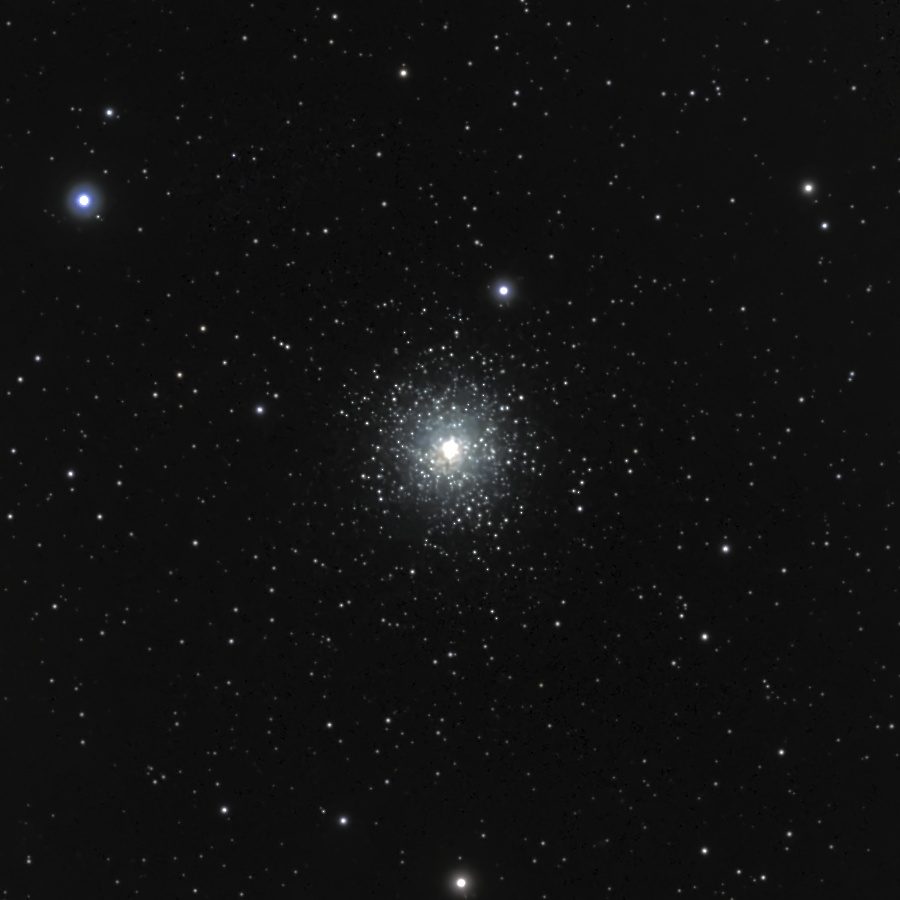
M15 — Globular Cluster in Pegasus
A hundred thousand ancient stars with a collapsed core
What you're looking at
M15 is one of the oldest globular clusters in the Milky Way — around 12 billion years, with a hundred thousand stars packed into a ball 175 light years wide. It orbits the galaxy far outside the disk, a relic from before the galaxy finished forming.
It's also one of the few clusters to have undergone core collapse: gravitational encounters over billions of years have funneled its heaviest stars into an extraordinarily dense center — possibly around an intermediate-mass black hole. Half the cluster's core light comes from a region only a tenth of a light-year across.
M15 also hosts Pease 1, the first planetary nebula ever discovered inside a globular cluster — a dying star's shed atmosphere glowing faintly amid a hundred thousand neighbors.
The lesson
Processing this image required treating the center and the edge as different problems.
Stretch for the faint halo stars and the core blows out into a featureless white disk. Protect the core and the halo disappears into the noise. The only honest image applies different curves to different regions — gentle where it's already bright, aggressive where it's starved.
Uniform policy across a non-uniform system destroys one end or the other. Segment first, then tune.
Object data
- Catalog
- M15 · NGC 7078
- Constellation
- Pegasus
- Type
- Globular cluster (core-collapsed)
- Distance
- ~33,600 light-years
- Diameter
- ~175 light-years
- Age
- ~12 billion years
- Notable resident
- Pease 1 — first planetary nebula found in a globular
- Discovery
- 1746 · Jean-Dominique Maraldi