
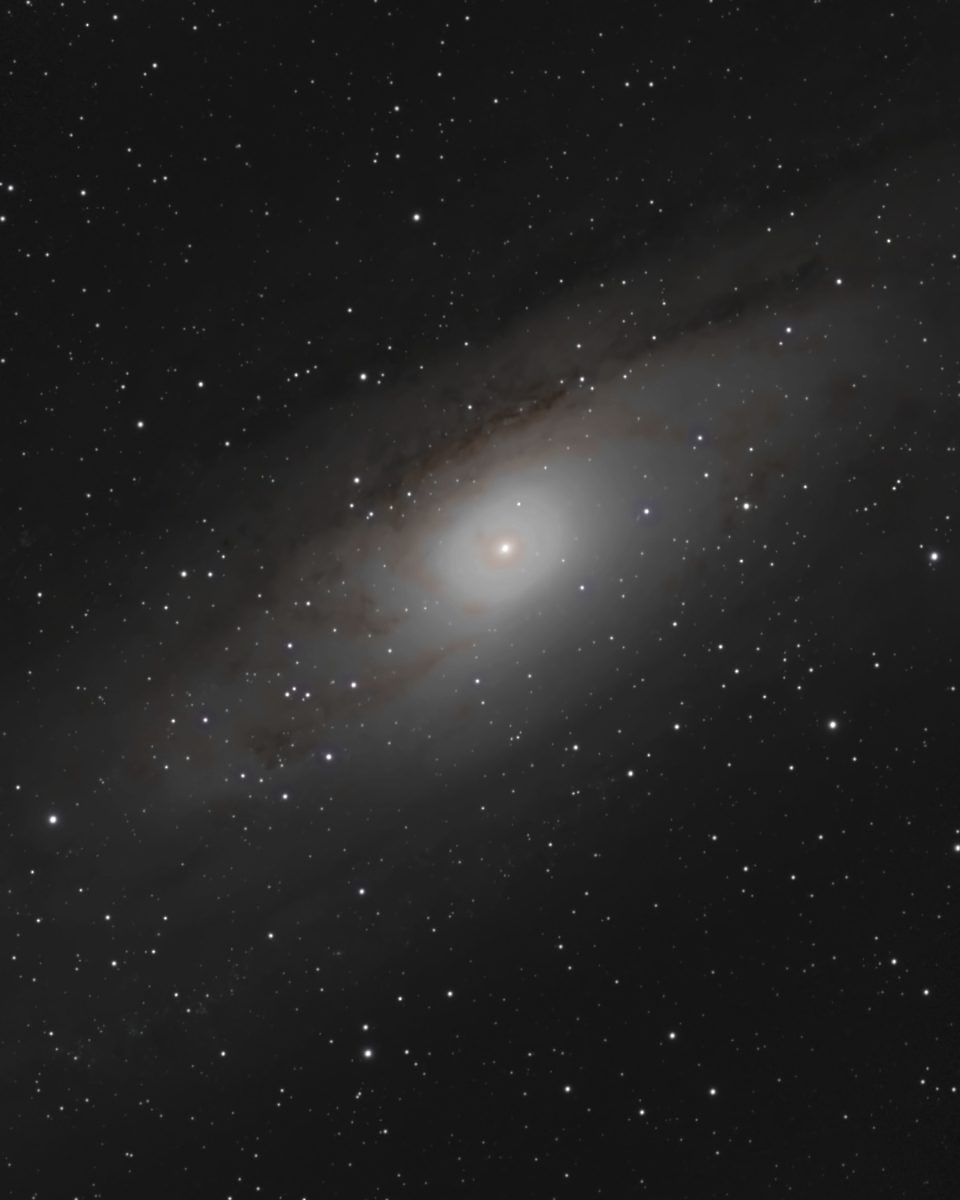
M31 — The Andromeda Galaxy
A trillion stars, and every photon older than our species
What you're looking at
M31 is the nearest large galaxy to our own and the most distant thing most humans will ever see with their naked eye — 2.5 million light years away. Every photon in this image left Andromeda before Homo sapiens existed, traveled the entire time our species was becoming itself, and ended its journey in a backyard in Texas.
It's bigger than the Milky Way — roughly a trillion stars — and it is coming at us at about 110 kilometers per second. In roughly 4.5 billion years the two galaxies will merge into a single giant elliptical. No stars will collide when it happens; galaxies are almost entirely empty space.
The dark streaks across the disk are dust lanes — the raw material of future stars, silhouetted against the glow of hundreds of billions of existing ones. The bright companion visible near the disk is M110, one of Andromeda's satellite galaxies.
The lesson
Andromeda is approaching at a quarter-million miles per hour, and the merger is still four and a half billion years out.
Both facts are true at once: dramatic motion, geological timescale. Nothing about tonight changes because of it, and everything about the far future does.
Most incoming change works this way. The right response to 'it's coming' is almost never panic and almost never denial — it's knowing which decade the impact actually lands in, and planning in that decade's units.
Object data
- Catalog
- M31 · NGC 224
- Constellation
- Andromeda
- Type
- Barred spiral galaxy
- Distance
- ~2.5 million light-years
- Star count
- ~1 trillion
- Approach speed
- ~110 km/s — merger with the Milky Way in ~4.5 billion years
- In frame
- Core, dust lanes, and satellite galaxy M110
- First recorded
- 964 AD · Abd al-Rahman al-Sufi ("the little cloud")