
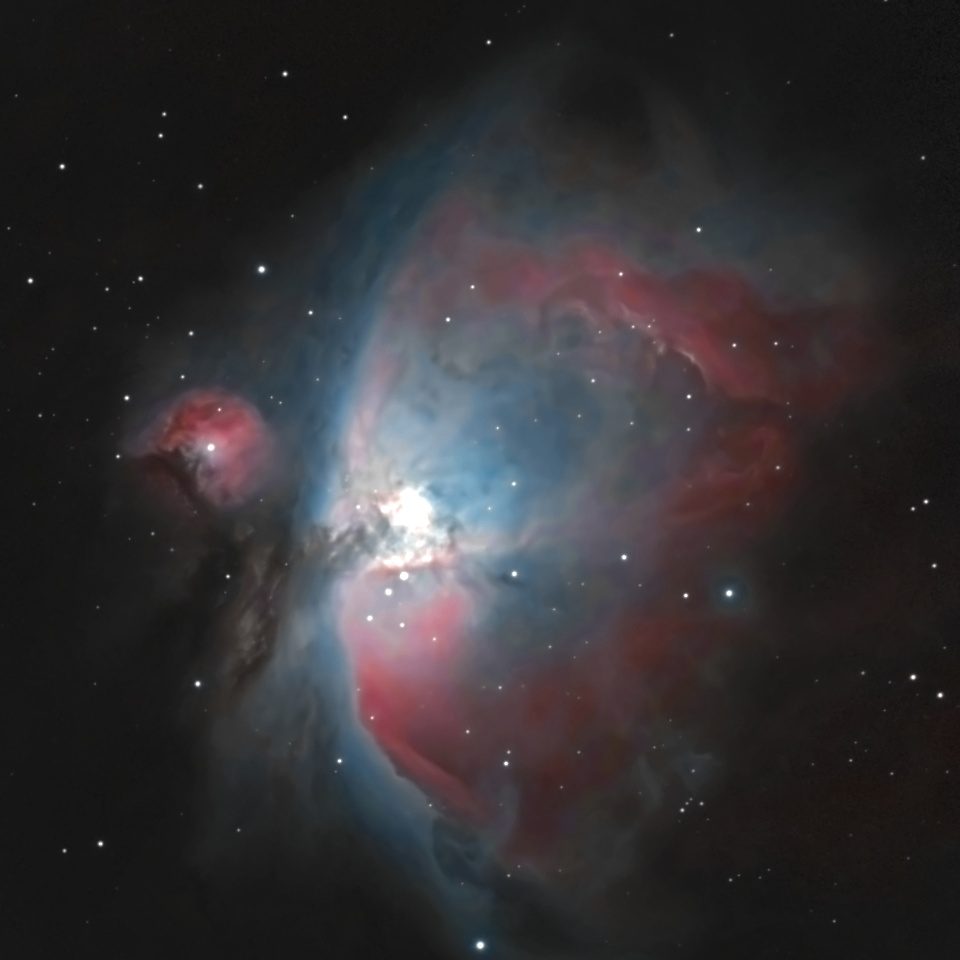
M42 — The Orion Nebula
The brightest stellar nursery in the sky, lit by four stars
What you're looking at
M42 is the nearest massive star-forming region to Earth — 1,344 light years away, bright enough to see with the naked eye as the fuzzy 'star' in Orion's sword. This entire cloud, 24 light years across, is a nursery where hundreds of stars are being born right now.
Almost all of its light traces back to just four stars: the Trapezium, the tight bright knot at the center of this frame. Four young giants, none older than a few hundred thousand years, pouring out enough ultraviolet radiation to ionize the whole nebula and blow its center into the open cavity we can see into.
The dark bay cutting toward the core — the 'Fish's Mouth' — is a foreground dust lane; the detached round glow beside the main nebula is M43, a separate lobe with its own illuminating star. Every star being born here will eventually drift apart into the galaxy: our own Sun likely formed in a nebula just like this, alongside siblings we've long since lost track of.
The lesson
Nearly everything glowing in this image runs on the output of four stars.
The Trapezium is a rounding error of the nebula's mass — four young stars out of hundreds forming — but their energy lights 24 light years of gas. Everything visible is downstream of a tiny, concentrated source.
Teams work the same way more often than anyone admits. Output isn't spread evenly across the org chart; find your Trapezium and build the environment around keeping it burning.
Object data
- Catalog
- M42 · NGC 1976
- Constellation
- Orion
- Type
- Emission nebula / stellar nursery
- Distance
- ~1,344 light-years — the nearest massive star factory
- Diameter
- ~24 light-years
- Power source
- The Trapezium — four young giant stars
- Also in frame
- M43 and the dark "Fish’s Mouth" dust lane
- Visible
- Naked eye, as the middle "star" of Orion’s sword