
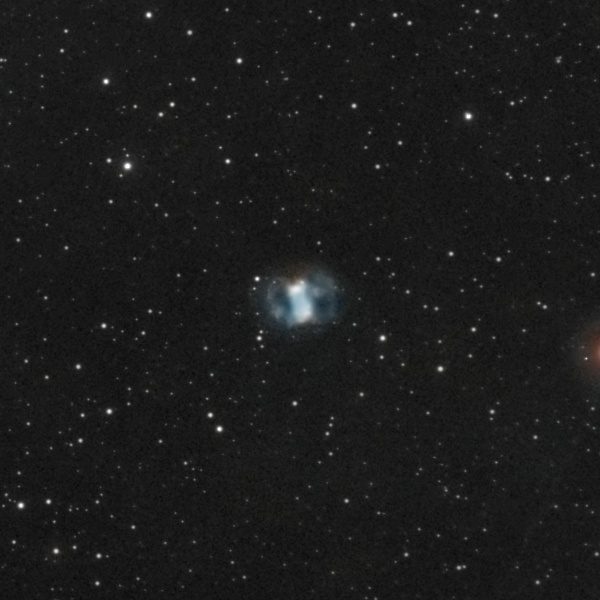
M76 — The Little Dumbbell
The faintest object in the Messier catalog
What you're looking at
M76 is a planetary nebula in Perseus — a dying Sun-like star that shed its atmosphere, seen not as a ring like M57 but as a barrel viewed from the side: two lobes of gas blowing out of a central torus, which gives it the 'Little Dumbbell' name.
At around magnitude 10, it's generally reckoned the faintest of the 110 objects in Charles Messier's catalog — the dimmest entry on the most famous observing list in astronomy. Its distance is genuinely uncertain, with estimates spanning 2,000 to 5,000 light years; planetary nebulae are notoriously hard to range.
The central star that shed all this is now a white dwarf hotter than 120,000 degrees — one of the hottest stars known — furiously ionizing its own cast-off atmosphere as it begins its long cooling into darkness.
The lesson
Messier's catalog was never a list of wonders. It was a list of annoyances — fuzzy things a comet-hunter kept mistaking for comets, written down so he could ignore them.
Two hundred fifty years later, nobody remembers most of Messier's comets. The ignore list became the most famous treasure map in amateur astronomy, and its faintest, least promising entry is the one that took this telescope 89 minutes of patient staring to capture.
Keep honest records of the things you're setting aside. Someone — possibly future-you — will discover the archive of distractions was the real work all along.
Object data
- Catalog
- M76 · NGC 650/651
- Constellation
- Perseus
- Type
- Planetary nebula (bipolar, seen side-on)
- Distance
- ~2,500–5,000 light-years (genuinely uncertain)
- Claim to fame
- Faintest object in the Messier catalog
- Central star
- White dwarf, >120,000 K — among the hottest stars known
- Discovery
- 1780 · Pierre Méchain