
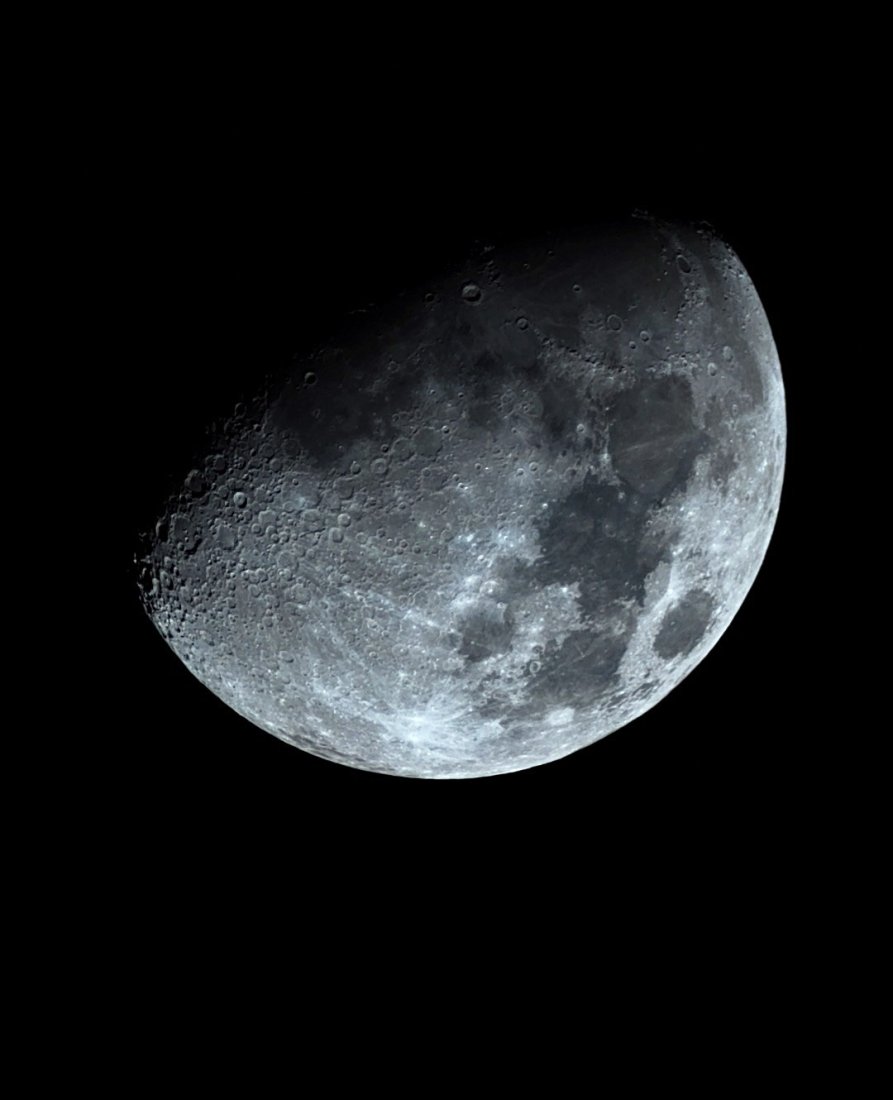
The Moon — Waxing Gibbous
The only world in this journal humans have walked on
What you're looking at
The Moon is the only object in this journal close enough to show a landscape: crater rims, lava plains, mountain ranges. Its light reaches the telescope 1.3 seconds after leaving the surface — everything else on this page is minutes to millions of years old.
The dark patches are maria — 'seas' of ancient basalt that flooded giant impact basins three billion years ago. The bright splashes radiating from young craters are ray systems: debris thrown across the face by impacts recent enough that space weathering hasn't yet darkened them.
Notice where the detail lives: along the terminator, the line between lunar day and night. There, the Sun grazes the surface at a low angle and every crater wall throws a long shadow. At full moon, with the Sun overhead, the same terrain photographs almost flat.
The lesson
All the texture is at the terminator — the boundary between light and dark. Under full, even illumination, the Moon's most dramatic terrain disappears into flatness.
Craters don't vanish at full moon. The shadows that reveal them do.
If you want to see the real shape of anything — a market, a team, a person — look at it under grazing light, where the edges throw shadows. Full illumination flatters; the boundary tells the truth.
Object data
- Object
- The Moon (waxing gibbous)
- Distance
- ~239,000 miles · 1.3 light-seconds
- Dark plains
- Maria — basalt flows ~3 billion years old
- Bright streaks
- Ray systems from geologically young impacts
- Detail zone
- The terminator — where shadows are longest
- Distinction
- Only world beyond Earth humans have visited
One photo. One lesson.
New entries land when the sky cooperates. Get them by email — no schedule, no spam, just what the telescope caught and what it taught.