
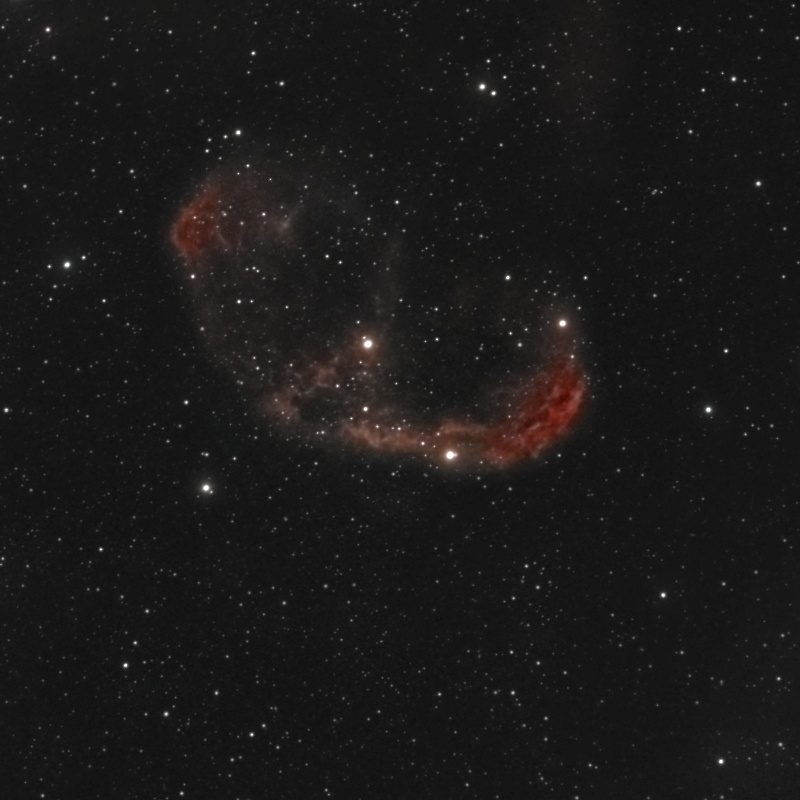
NGC 6888 — The Crescent Nebula
A dying giant inflating a 25-light-year bubble, 5,000 light years away
What you're looking at
The unremarkable-looking star at the center of this shell is WR 136, a Wolf-Rayet star — a dying giant shedding its own outer layers at millions of miles per hour. The crescent is the collision front where that ferocious wind slams into gas the star exhaled thousands of years earlier, when it was a calmer red giant.
The shell spans about 25 light-years and has been inflating for roughly a quarter of a million years. The bright rims are where the collision is compressing hydrogen until it glows; the mottled lacework across the interior is the same collision seen face-on.
WR 136 is running out of time. Wolf-Rayet stars are massive stars in their final act — within a few hundred thousand years it will likely go supernova, erasing the crescent and replacing it with a remnant like the Veil Nebula a few degrees away. This image is a photograph of the 'before.'
The lesson
The shell exists because the star's past and present are colliding.
The slow wind it exhaled as a red giant is being caught and compressed by the fast wind it drives now. The crescent — the only visible structure, the whole photograph — is the interface between who the star was and who it became.
The friction between your old life and your new one isn't a problem to eliminate. Handled right, it's the only part that glows.
Object data
- Catalog
- NGC 6888 · Caldwell 27
- Constellation
- Cygnus
- Type
- Wolf-Rayet shell nebula
- Distance
- ~5,000 light-years
- Diameter
- ~25 light-years
- Central star
- WR 136 — sheds a Sun’s worth of mass every ~10,000 years
- Age of shell
- ~250,000–400,000 years
- Fate
- Supernova, on an astronomical timescale soon
- Discovery
- 1792 · William Herschel