
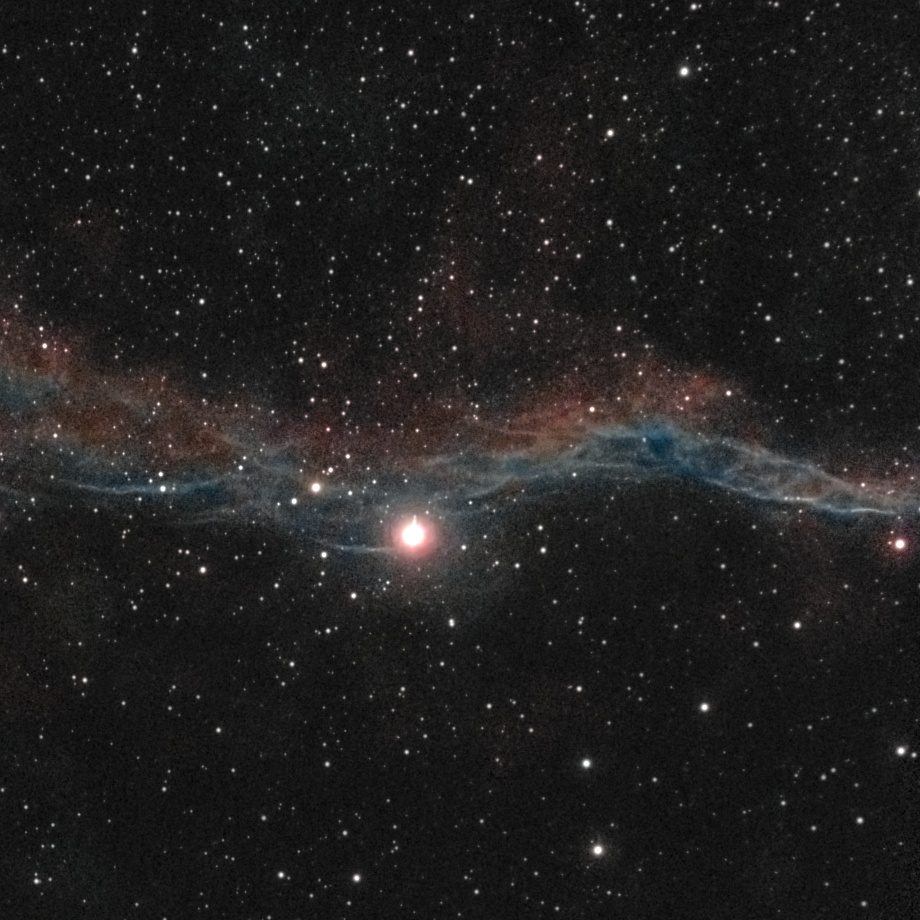
NGC 6960 — The Witch's Broom
The Western Veil, with a naked-eye star impaled on it
What you're looking at
This is the western arc of the same explosion featured in the Eastern Veil entry — the other edge of the expanding shock bubble, 10,000 years along. The braided shaft is where the blast wave slices through interstellar gas nearly edge-on to our line of sight, compressing it into glowing filaments.
The bright star skewered through the middle, 52 Cygni, is a complete coincidence — a foreground star barely 200 light years away, ten times closer than the nebula behind it. It's bright enough to see with the naked eye, which makes the Broom one of the easiest deep-sky objects to *find* and one of the hardest to photograph well: the star constantly threatens to overwhelm the wisps.
Together with the Eastern arc, the two Broom-and-Bone halves bracket a bubble of shocked gas roughly 120 light years across — large enough that light from one edge takes more than a century to reach the other.
The lesson
This target was recommended, scheduled, and postponed twelve separate times over three weeks. Every night, something newer or shinier won the telescope.
It was never hard. It was never risky. It was the single highest-confidence target on the list — which is exactly why it kept losing to things that felt more urgent. Guaranteed wins don't generate urgency.
The important-but-not-urgent quadrant is where sure things go to wait. Put them on the calendar like they're emergencies, because nothing else will ever make room for them.
Object data
- Catalog
- NGC 6960 · Caldwell 34 (Western Veil)
- Constellation
- Cygnus
- Type
- Supernova remnant (Cygnus Loop)
- Distance
- ~2,400 light-years
- Foreground star
- 52 Cygni — ~200 light-years, unrelated, naked-eye visible
- Companion entry
- /astronomy/veil-nebula-east — the other half of the blast
- Discovery
- 1784 · William Herschel