
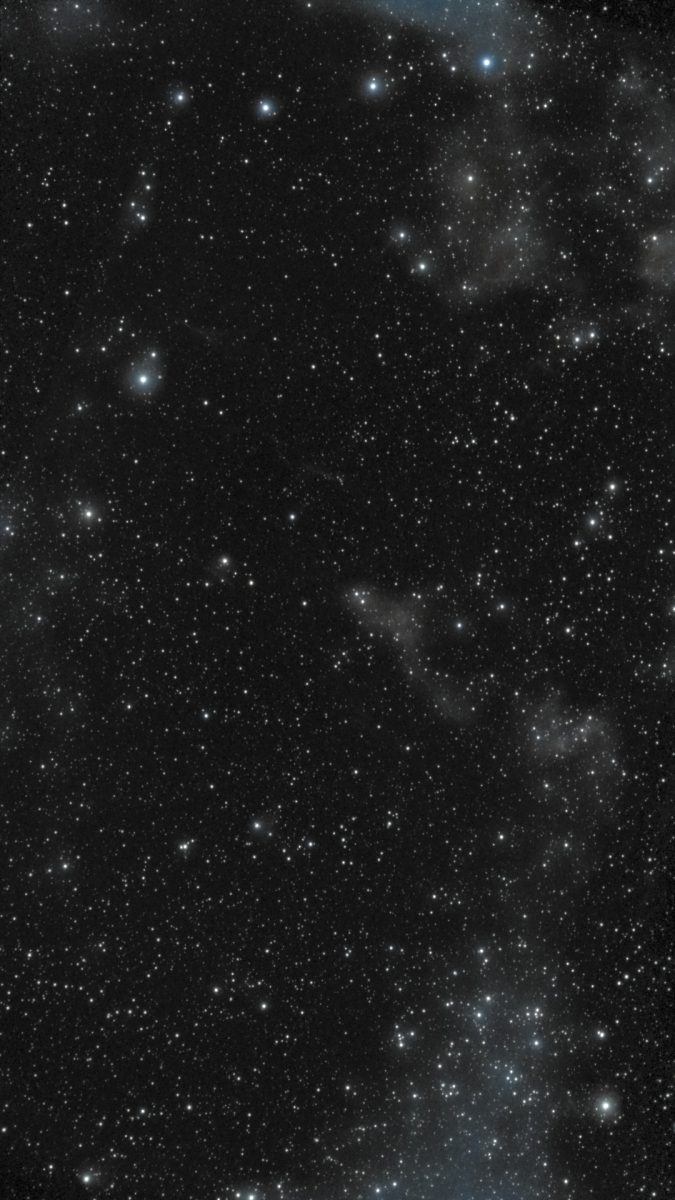
NGC 6979 — Pickering's Triangle
The faintest corner of the Veil, and the woman who actually found it
What you're looking at
This is the faintest major section of the Veil supernova remnant — a triangle of shredded wisps between the two bright arcs. It's so faint that nobody saw it through an eyepiece for over a century of telescopic astronomy; it was discovered in 1904 on long-exposure photographic plates at Harvard.
The discovery is credited in the name to Edward Pickering, the observatory director. The person who actually found it was Williamina Fleming — a Scottish housekeeper Pickering hired as a 'computer,' who went on to discover hundreds of nebulae and stars, including the Horsehead Nebula. Convention of the era gave the boss the name.
The wisps are the same 10,000-year-old supernova shock front as the rest of the Veil, just running through thinner gas — less material to sweep up means less light to give off.
The lesson
The name on the object belongs to the director. The discovery belongs to Williamina Fleming.
She found this — and the Horsehead, and hundreds of other objects — doing painstaking plate analysis that the man whose name is on the triangle never did. The credit architecture of 1904 routed her work upward by default.
When you run a team, the naming rights flow to you automatically. Route them back down. It costs nothing and it's the difference between Pickering's legacy and Fleming's.
Object data
- Catalog
- NGC 6979 (Pickering’s Triangle region)
- Constellation
- Cygnus
- Type
- Supernova remnant (Cygnus Loop, faint section)
- Distance
- ~2,400 light-years
- Discovered
- 1904, photographically — by Williamina Fleming
- Named after
- Her boss