
NGC 7000 — Inside the North America Nebula
A frame with no sky in it, 2,600 light years away
What you're looking at
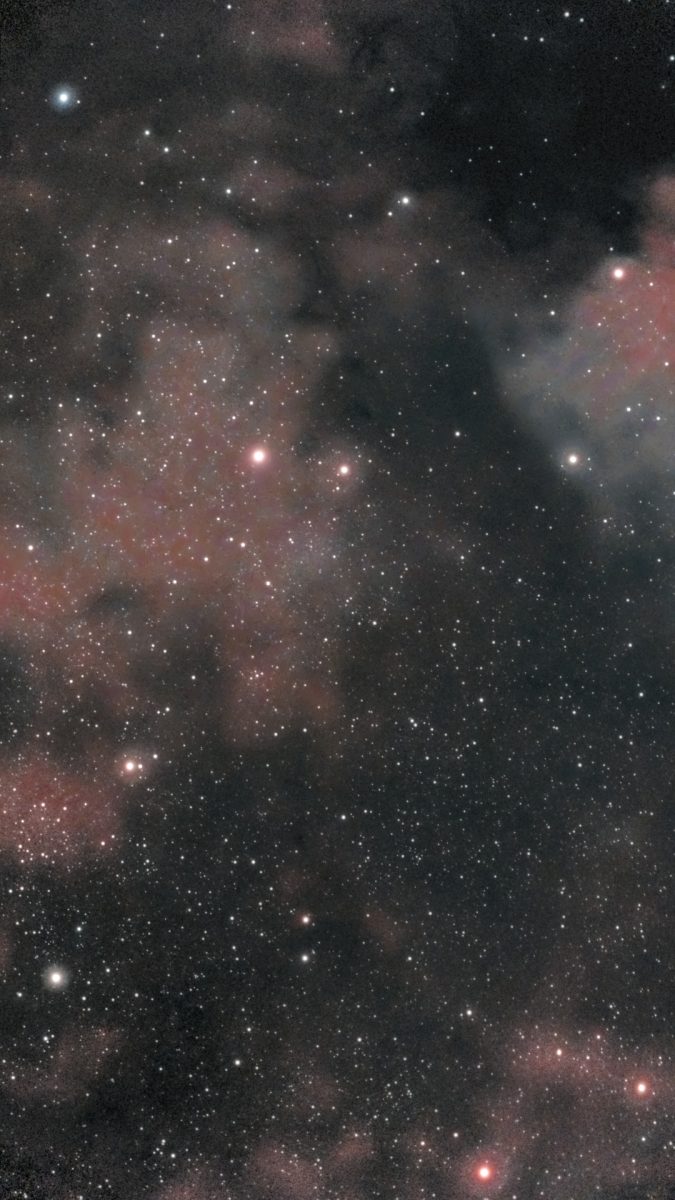
NGC 7000 spans four full moons of sky in Cygnus — so large that this telescope's entire field of view fits inside it. This frame is pointed at the nebula's interior: everything glowing salmon-red is ionized hydrogen, and the coal-black region in the corner isn't empty space but the dense 'Gulf of Mexico' dust lane that gives the nebula its continental shape.
For decades nobody knew which star powers all this. The culprit — nicknamed the Bajamar Star — hides inside that dark dust lane, revealed only by Gaia satellite data in 2020. The lighthouse of the whole nebula is invisible from Earth, buried in its own dust.
The whole complex sits about 2,600 light years away and shares its hydrogen cloud with the neighboring Pelican Nebula — they're one object, divided by a river of foreground dust.
The lesson
This capture looked like a total failure — a gray, featureless haze. It was actually a direct hit.
The frame was pointed inside the target, so there was no dark sky anywhere to give the eye contrast. Every instinct said nothing was captured, when the truth was the opposite: the subject was everywhere.
When everything looks like nothing, check whether you're inside the thing you were looking for. Total immersion and total absence look identical from the middle.
Object data
- Catalog
- NGC 7000 · Caldwell 20
- Constellation
- Cygnus
- Type
- Emission nebula (H II region)
- Distance
- ~2,600 light-years
- Apparent size
- ~4 full moons — larger than this telescope’s field of view
- Powering star
- The Bajamar Star — hidden in the dust, identified only in 2020
- Dark region in frame
- The "Gulf of Mexico" dust lane (LDN 935)
- Discovery
- 1786 · William Herschel