
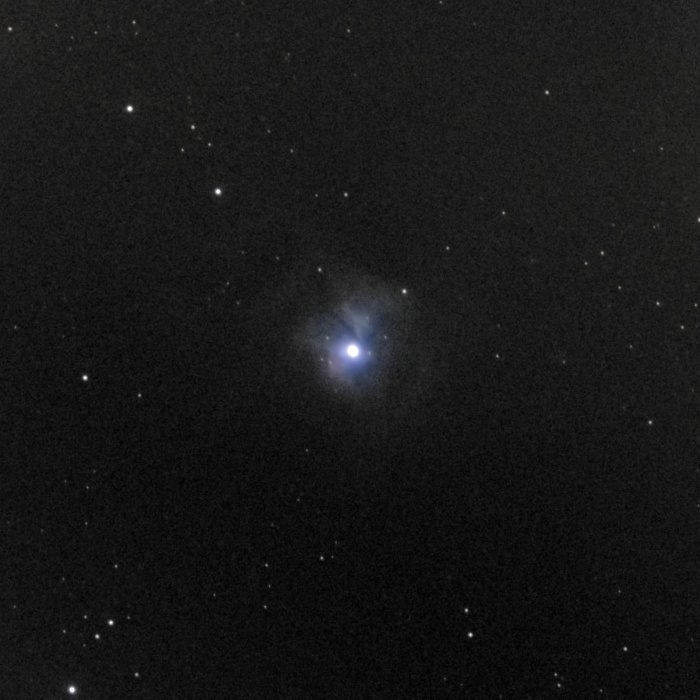
NGC 7023 — The Iris Nebula
Starlight mirrored by dust, 1,300 light years away
What you're looking at
Thirteen hundred light-years away in Cepheus, a young star ignites a flower. The Iris isn't a glowing gas cloud like most nebulae — it's a cloud of fine dust acting as a mirror, and the blue isn't paint: the dust scatters blue starlight far better than red, the very same physics that colors Earth's daytime sky.
In effect, it's what "sky blue" looks like when the sky belongs to another star. The petals of the flower span about six light-years, and the whole bloom sits wrapped in a much larger shroud of dark dust that swallows the starlight entirely.
The star at its heart is barely 5,000 years into lighting up its cocoon — a cosmic newborn. Thirty minutes of integration captured the bright core; the vast dark dust field around it is a multi-hour project for a darker month.
The lesson
This object forced a real decision at the telescope: the filter that makes most nebulae possible would have erased this one.
Emission nebulae glow on two exact wavelengths, so you can wall off everything else. The Iris shines across the whole spectrum — put up the wall and you lose the subject with the noise.
Tools aren't good or bad. They're matched or mismatched. The skill isn't owning the filter — it's knowing which physics you're pointed at.
Object data
- Catalog
- NGC 7023 · Caldwell 4
- Constellation
- Cepheus
- Type
- Reflection nebula
- Distance
- ~1,300 light-years
- Bright core
- ~6 light-years across
- Illuminating star
- HD 200775 · young B-type, ~5,000 years into clearing its cocoon
- Why blue
- Dust scatters short wavelengths best — same reason Earth’s sky is blue
- Discovery
- 1794 · William Herschel