
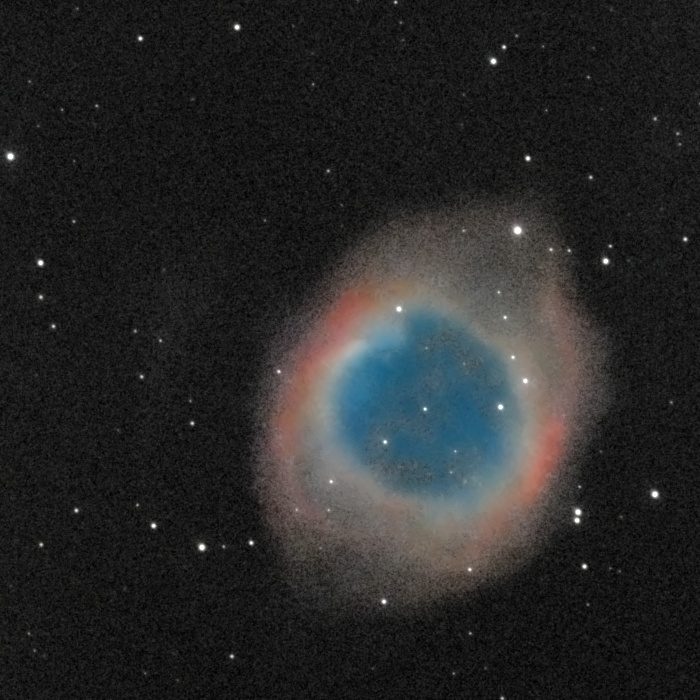
NGC 7293 — The Helix Nebula
The nearest bright planetary nebula — the Sun's future, 650 light years away
What you're looking at
The Helix is the nearest bright planetary nebula to Earth — the shed atmosphere of a dying Sun-like star, only about 650 light years away in Aquarius. Its size and stare have earned it the nickname the Eye of Sauron (astronomers less steeped in Tolkien call it the Eye of God).
The colors map the physics directly. The teal interior is oxygen — doubly ionized by the fierce ultraviolet of the exposed stellar core, emitting at a wavelength so improbable it effectively cannot be produced in any laboratory on Earth; the gas must float undisturbed in near-perfect vacuum for hours before it releases its photon. The red rim is cooler hydrogen at the shell's edge.
At the center sits the white dwarf that used to be the star — Earth-sized, half the Sun's mass, cooling forever. In roughly 5 billion years, the Sun will do exactly this. This image is a family photo from the future.
The lesson
The teal light in this image cannot be made on Earth. Not won't — can't.
The oxygen transition that produces it is so fragile that any collision cancels it. In a lab, there's always a collision. Only in the emptiness of a nebula, where an atom can drift for hours untouched, does that light get to exist.
Some things only emerge in space that pressure can't reach. If you never have an undisturbed hour, there are thoughts you will simply never have.
Object data
- Catalog
- NGC 7293 · Caldwell 63
- Constellation
- Aquarius
- Type
- Planetary nebula
- Distance
- ~650 light-years (nearest bright planetary)
- Diameter
- ~3 light-years
- Age
- ~10,600 years since the star shed its envelope
- Central object
- White dwarf — the Sun’s eventual fate
- Teal interior
- Doubly-ionized oxygen — the "forbidden line"
- Discovery
- ~1824 · Karl Ludwig Harding