
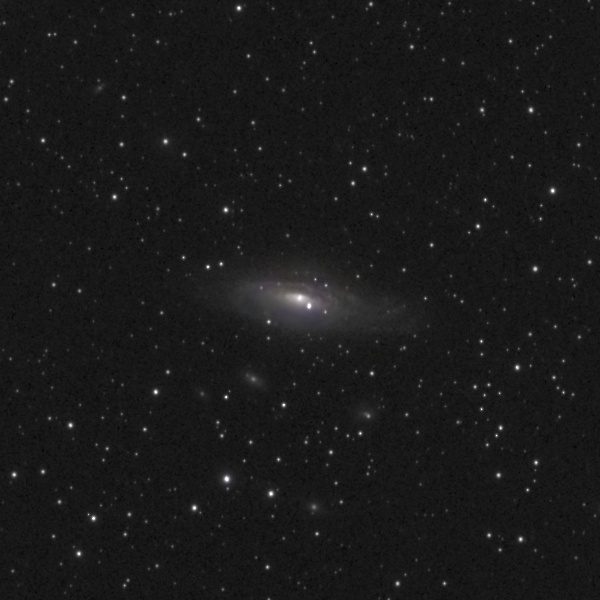
NGC 7331 — The Deer Lick Galaxy
The Milky Way's twin, 40 million light years away
What you're looking at
Forty million light years away in Pegasus floats the galaxy astronomers call the Milky Way's twin — a spiral so similar in size and structure to our own that when you look at NGC 7331, you're essentially seeing our galaxy's reflection. It earned its down-home nickname from Deer Lick Gap in the Smoky Mountains, where one observer had a particularly memorable night viewing it.
The smaller galaxies huddled around it — affectionately called "the fleas" — are an optical trick: they're not companions at all, but background galaxies up to ten times farther away, their light leaving them when Earth's continents were still deciding where to sit.
Just half a degree away (barely off the edge of this frame) sits Stephan's Quintet, the most famous compact galaxy group in the sky. One deliberate framing can catch both — it's on the list for the next dark window.
The lesson
The fleas look like companions. They're not even in the same neighborhood.
Everything in this frame reads as one gravitationally-bound family, and almost none of it is — the "satellites" are hundreds of millions of light years behind the main galaxy, projected together by the accident of our viewing angle.
Proximity in a snapshot isn't relationship. Before you assume two things are connected because they show up together, check the distances.
Object data
- Catalog
- NGC 7331 · Caldwell 30
- Constellation
- Pegasus
- Type
- Unbarred spiral galaxy (SA(s)b)
- Distance
- ~40 million light-years
- Diameter
- ~120,000 light-years (≈Milky Way)
- The "fleas"
- Background galaxies ~300–350 million light-years behind
- Neighbor
- Stephan's Quintet, ~30 arcminutes away (just off-frame)
- Discovery
- 1784 · William Herschel