
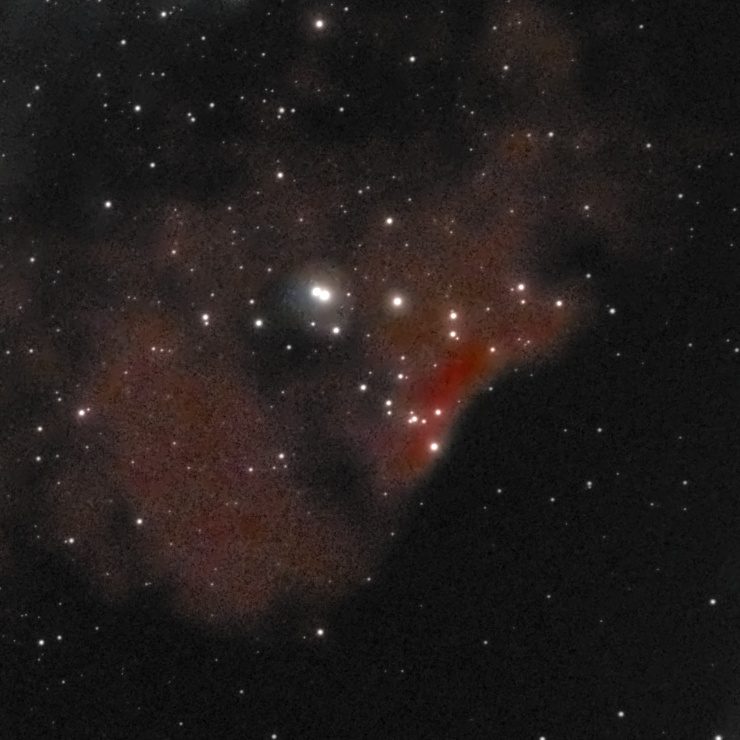
Sh2-140 — A Bright Rim on a Dark Cloud
A star eroding a molecular cloud, 2,900 light years away
What you're looking at
Sh2-140 is the glowing edge of a war between a star and a cloud. A hot B-type star sits just off the face of a dark molecular cloud in Cepheus, and its ultraviolet radiation is eating into the cloud's surface — the bright red rim in this image is the erosion front, hydrogen ionized until it glows.
Behind the rim, inside the dark cloud, infrared telescopes have found a cluster of protostars still forming — the same radiation that erodes the cloud face also compresses it, triggering the collapse of new stars deeper in. Destruction on one face, construction just behind it.
The dark wedge below the rim isn't empty sky. It's the cloud itself — dense enough to swallow all the starlight behind it.
The lesson
Same night, same target, same sky. Ninety-one minutes through the wrong filter lost to fifty-seven through the right one.
The broadband run collected more total light — and less of the thing that mattered, because it let the whole sky in with it. The narrowband run collected less light, almost all of it signal.
More effort through the wrong channel loses to less effort through the right one. It isn't even close, and now I have the two files to prove it.
Object data
- Catalog
- Sharpless 2-140
- Constellation
- Cepheus
- Type
- Bright-rimmed molecular cloud edge (H II region)
- Distance
- ~2,900 light-years
- Ionizing star
- HD 211880 (B0.5V)
- Hidden inside
- A cluster of embedded protostars, visible only in infrared
- Structure
- Erosion front outside, triggered star formation inside