
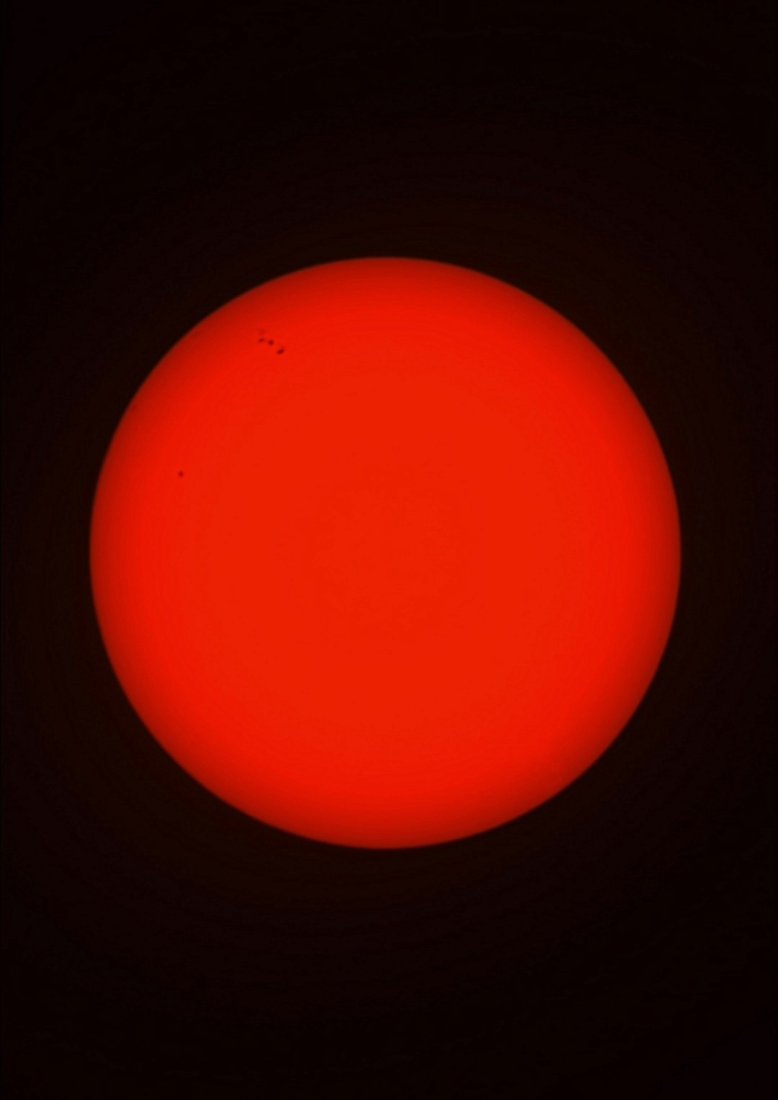
The Sun — White Light, With Sunspots
The only star close enough to have a surface
What you're looking at
Every deep-sky object in this journal is a star or the wreckage of one, rendered soft by unimaginable distance. This is what a star looks like from close up: 93 million miles, near enough that its light is only 8 minutes and 20 seconds old when it hits the sensor.
The dark specks in the upper-left quadrant are sunspot groups — regions where the Sun's magnetic field punches through the surface and suppresses the convection that keeps the rest of the disk at 5,500°C. They look tiny; each spot is roughly the size of Earth.
The Sun is a G2V dwarf, the same class of star being born by the hundreds in the M42 entry, and destined for the same fate previewed in the Ring, Dumbbell, and Helix entries — red giant, shed atmosphere, white dwarf. This journal accidentally documents its entire biography, past and future, one nebula at a time.
The lesson
This is the same kind of object as everything else on the page — the only difference is distance.
Up close: a surface, storms, structure, violence. From far away: a point of light indistinguishable from ten thousand others. Neither view is wrong; they're the same star at different ranges.
Worth remembering when you compare your inside view of your own work — all storms and sunspots — against everyone else's distant, point-source highlight reel.
Object data
- Object
- The Sun (G2V main-sequence star)
- Distance
- ~93 million miles · 8.3 light-minutes
- Diameter
- ~109× Earth
- Dark spots
- Sunspot groups — magnetic storms, each roughly Earth-sized
- Surface temp
- ~5,500°C (sunspots ~1,500° cooler)
- Future
- See the Ring, Dumbbell, and Helix entries — in ~5 billion years
One photo. One lesson.
New entries land when the sky cooperates. Get them by email — no schedule, no spam, just what the telescope caught and what it taught.