
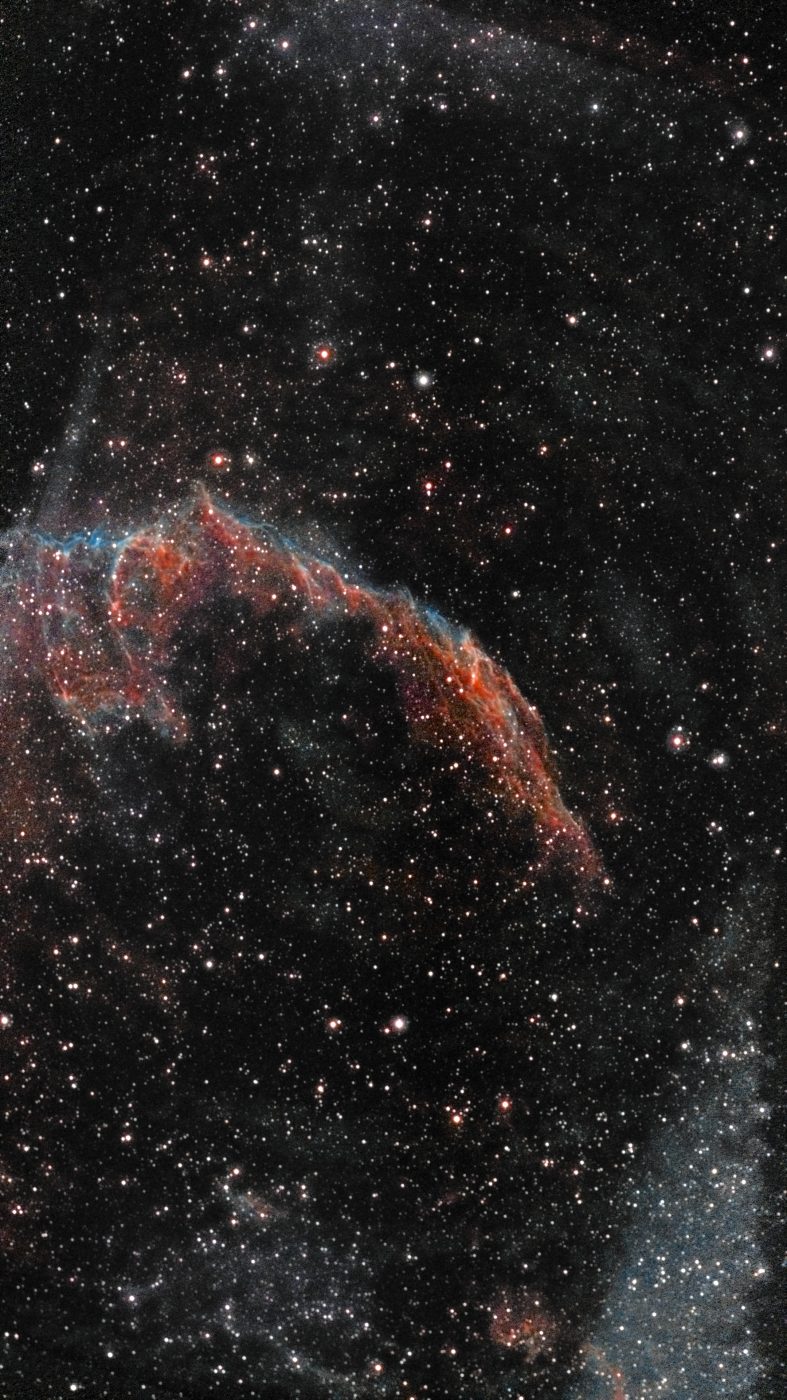
The Eastern Veil — First Light, Seestar S50 Pro
A new telescope opens on familiar wreckage
What you're looking at
Same supernova wreckage as the Eastern Veil entry from two weeks ago — the shock front of a star that detonated 10,000 years ago — but through a new instrument: the Seestar S50 Pro's dual-band filter passes only the two exact wavelengths this object emits (hydrogen red, oxygen teal) and rejects nearly everything else, including most of suburban Texas.
The upgrade that matters most here isn't sharpness — it's real estate. The Pro's field is nearly four times wider, and at the corners of this frame you can already see faint wisps of the Western Veil and the loop's central sections photobombing an Eastern Veil portrait. The entire Cygnus Loop — six full moons of sky — nearly fits in a single frame.
That's the project this image starts: the complete supernova remnant, corner to corner, one photograph. The pieces already exist across three other entries on this page; this frame is the first draft of the whole.
The lesson
First light on new gear is usually a debugging session. This one produced a keeper on night one.
Not because the new telescope is easy — because every mistake it could invite had already been made and paid for on the old one: wrong filters, bad framings, unmeasured skies, impatient stretches. The new tool inherited practiced hands.
Upgrade the gear last. Skill transfers on day one; a better instrument amplifies whatever operator shows up — including a sloppy one.
Object data
- Catalog
- NGC 6992 · Caldwell 33 (Eastern Veil)
- Instrument
- Seestar S50 Pro — first light
- Filter
- Dual-band OIII (501nm) / Hα (656nm)
- Sensor
- 4K (2160×3840) — 4× the pixels of the S50
- Field of view
- ~2.5° — most of the Cygnus Loop in one frame
- Bonus in frame
- Faint sections of the Western Veil at the edges
- Next
- EQ mode (60-second subs) and the full-loop portrait