NGC 6992 — The Eastern Veil Nebula
A supernova shock front, built from two nights of light
What you're looking at
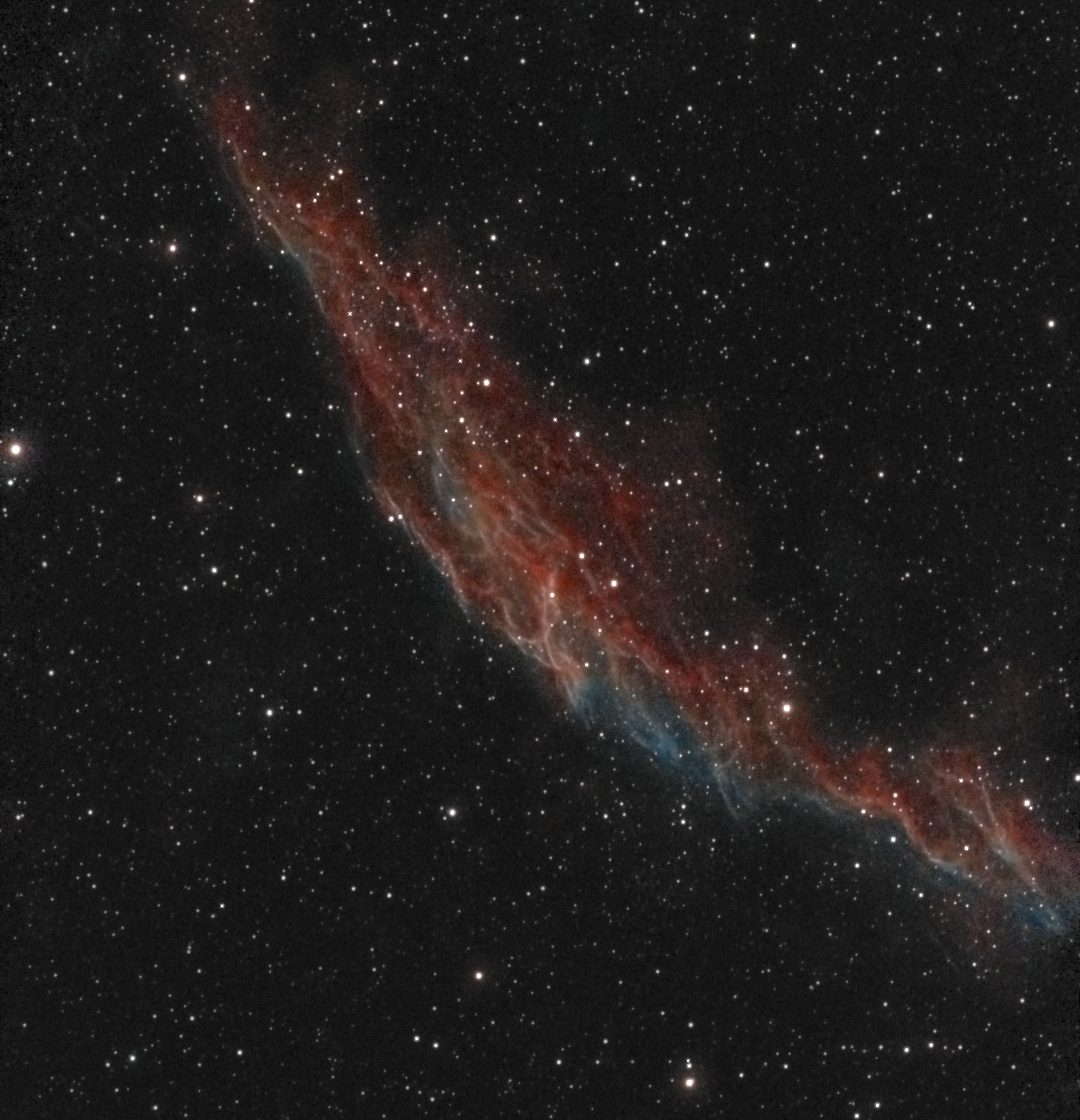
About 10,000 years ago, a star twenty times the Sun's mass detonated in Cygnus. The Veil Nebula is the wreckage: a shock wave still expanding after a hundred centuries, now spanning six full moons of sky. This arc — the Eastern Veil — is its brightest section.
The braided texture is the shock front itself, seen edge-on wherever it slices through interstellar gas. The colors are chemistry: red filaments are hydrogen glowing at exactly 656 nanometers, teal ones are oxygen at 501 — two fixed, quantum-locked wavelengths that make up nearly all of this object's light.
When the light in this image left the nebula, humans were building the first cities. The blast wave has been traveling the whole time — it's still moving at over 100 kilometers per second, and will keep dissolving into the interstellar medium for tens of thousands of years more.
The lesson
This image is two ordinary nights combined — one 50-minute session, one 100-minute session, aligned until their light landed on the same pixels.
Neither night's data was impressive alone. The first was a promising sketch; stacked together, the noise averaged down, the filaments came up, and the result outclassed anything a single session could produce.
Compounding requires registration. Two efforts that don't line up just coexist; two efforts aligned to the same target, they accumulate. The alignment is the work.
Object data
- Catalog
- NGC 6992 · Caldwell 33 (Eastern Veil)
- Constellation
- Cygnus
- Type
- Supernova remnant (Cygnus Loop)
- Distance
- ~2,400 light-years
- Age of blast
- ~10,000 years
- Progenitor
- A star ~20× the Sun’s mass
- Full loop size
- ~6 full moons across the sky
- Colors
- Red = hydrogen (656nm) · Teal = oxygen (501nm)
- Discovery
- 1784 · William Herschel