Barnard 33 — The Horsehead Nebula
A pillar of dust standing in front of a wall of light
What you're looking at
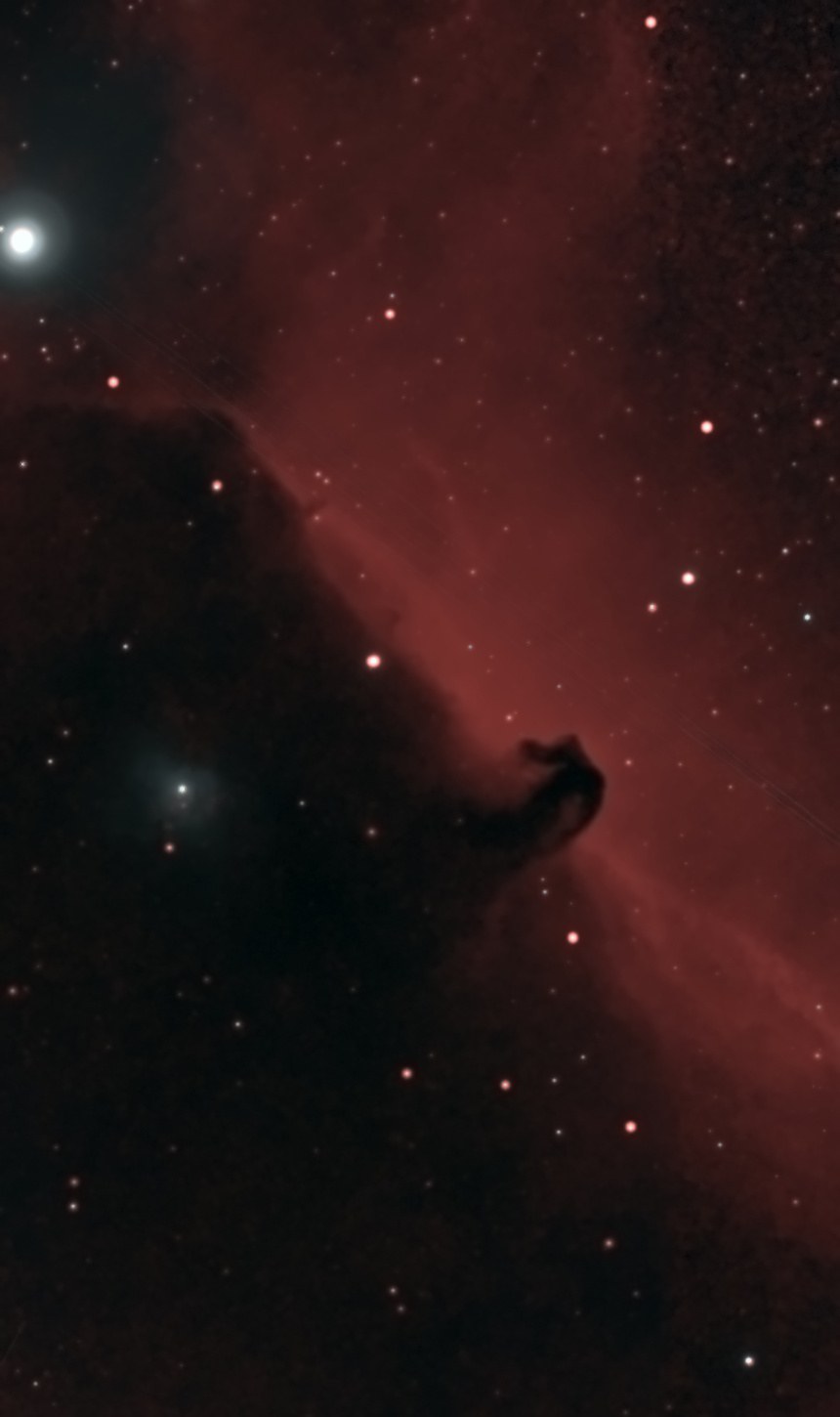
The Horsehead is not a glowing object. It is a pillar of cold, dense dust and gas, part of the Orion B molecular cloud about 1,400 light-years away, seen in silhouette because it stands in front of IC 434, a sheet of hydrogen lit up by the hot star Sigma Orionis just out of frame. The head is roughly three and a half light-years tall.
The same starlight that makes the curtain glow is slowly eroding the pillar. The Horsehead is a feature that exists for a few million years, a blink in astronomical time, carved out of the larger dark cloud that fills the lower half of this frame.
Inside that dark cloud, the small glow at left is NGC 2023: a young star still wrapped in the dust it formed from, lighting it from within. Williamina Fleming first spotted the Horsehead in 1888 on a photographic plate at Harvard, where she worked cataloguing the sky.
The lesson
The first night, the target was there and the picture still failed: the frame rotated and the horse ended up sliced at the edge.
The fix was not a better telescope. It was aiming at the point that survives the rotation, the midpoint between the two things that mattered, so neither could fall off the edge.
Plans fail at the edges first. Center on what has to survive, and let the rest be margin.
One photo. One lesson.
New entries land when the sky cooperates. Get them by email, plus the Sitreps jobs newsletter — no schedule, no spam. Unsubscribe from either one anytime.
Object data
- Catalog
- Barnard 33 · against IC 434 · with NGC 2023
- Constellation
- Orion
- Type
- Dark nebula in front of an emission nebula
- Distance
- ~1,400 light-years
- Size
- About 3.5 light-years from chin to ears
- Integration
- 1,407 × 10 s over two nights = about 3.9 hours