
Field notes · Seestar
Should You Stack Your Seestar Subs in Siril? What One Measured Night Showed
Measured on one night of M51: the onboard stack beat a Siril stack of the same subs, and GraXpert AI denoise on the onboard stack beat everything
The short answer
For a Seestar owner, the scope’s own stack was the better starting point, and running AI noise reduction on it was the single biggest improvement. Stacking the saved individual subs in Siril didn’t beat the scope’s stack, even after giving the Siril stack the same AI noise reduction.
This is one night, one target and one telescope, and the comparison isn’t perfectly like-for-like (details below). Treat it as a measured data point, not a law.
The test
On June 10, 2026, my Seestar S50 shot 442 ten-second subs (individual frames) of M51, the Whirlpool Galaxy, from Lakeway, Texas (Bortle 6): about 73 minutes. The scope built its own stack from 434 of them, and it also saved every individual sub.
I stacked the saved subs in Siril 1.4.4, a free, open-source stacking program, with two-pass star alignment and winsorized outlier rejection. Siril aligned 357 of the 442 subs and dropped the other 85.
To compare fairly, I matched the brightness of the two stacks using 359 stars measured in both. Signal-to-noise here is the galaxy’s median brightness divided by the pixel-to-pixel grain in empty background sky. That grain is exactly what noise reduction smooths, so read the numbers with that in mind. I also measured the contrast of the spiral arms the same way in each, then ran GraXpert’s AI noise reduction on each stack while the data was still linear (before stretching) and measured again.
| Version | Signal-to-noise | Subs stacked | Noise reduction |
|---|---|---|---|
| Seestar’s own stack | 37 | 434 | Seestar built-in |
| Siril stack of the saved subs | 18 | 357 | none |
| Seestar’s stack + AI denoise | 58 | 434 | built-in + GraXpert |
| Siril stack + AI denoise | 32 | 357 | GraXpert |
Why the scope’s own stack won, and what I haven’t tested
Two differences stand out, and I haven’t yet tested which one matters more. First, the Seestar runs its own noise reduction on the stack it builds, and the subs I stacked in Siril got none. Second, the scope applies dark-frame calibration inside its own stacking; owners disagree about whether the individual subs it saves get the same correction, and I haven’t checked.
The 85 subs Siril couldn’t align explain only a small part of the gap, about 10% more noise. The fairest single comparison in the table is the Siril stack with AI noise reduction (32) against the scope’s own stack (37): the scope still won, by a smaller margin. I also didn’t try drizzle integration, which Siril can do with saved subs and which I left switched off on the scope. Next I’ll repeat the test with my own dark frames and a drizzle run to separate these effects.
What did help: AI noise reduction on the linear stack
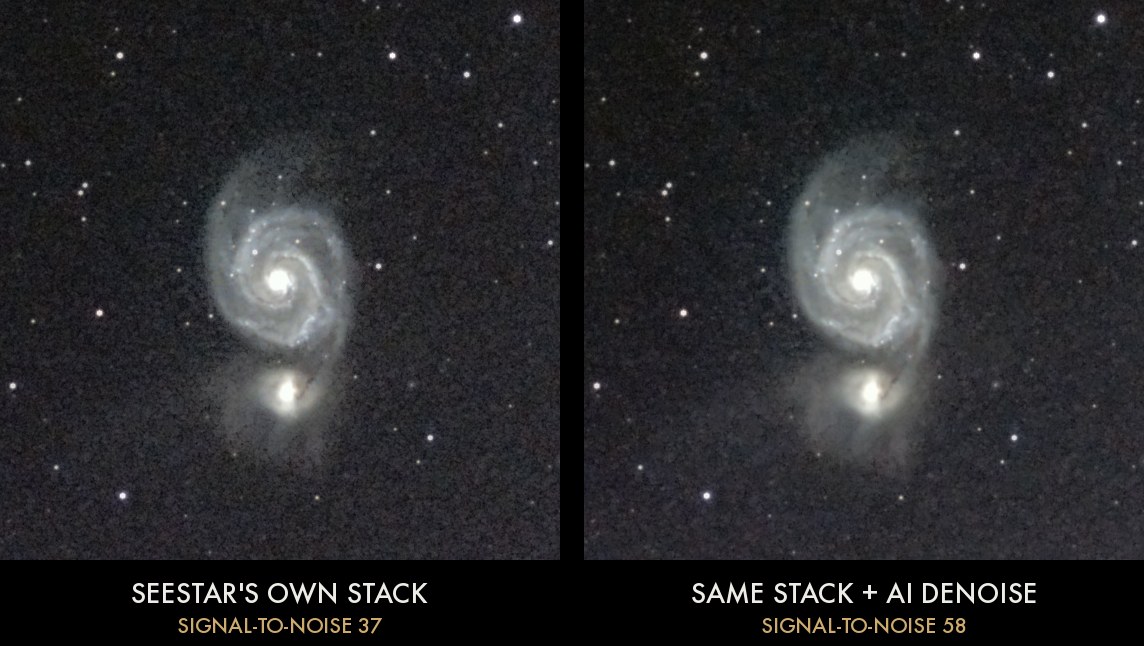
GraXpert’s AI denoise took the scope’s stack from a signal-to-noise of 37 to 58, with the spiral-arm contrast unchanged. On this measure, that is the kind of smoothness you would otherwise need roughly two and a half times the exposure to get. But it is smoothing, not new signal: noise reduction can’t recover detail that was never captured, and pushed hard it can invent texture. The faintest real detail still comes only from more time on target.
After a full stretch, the difference is easy to see in the comparison at the top of this page: a cleaner background, with the Whirlpool’s faint outer glow and the haze around its companion galaxy rising out of the grain.
What didn’t help: AI sharpening
In a separate test on an S50 Pro frame of the Rosette Nebula, GraXpert’s AI deconvolution made no measurable difference: star width went from 3.24 to 3.23 pixels. Seestar stars span only about three pixels, because the pixels are large compared with stars the atmosphere has already blurred, so there is little fine blur for these tools to undo. I’d test a sharpening tool on your own stack before paying for one for Seestar data.
How to do it
- Keep the scope’s stacked result as a FITS file, not just the JPEG, so the data is still linear.
- Run AI noise reduction on that linear file. GraXpert is free and has a denoise mode.
- Then stretch and color the denoised file in whatever you already use.
- Turn on saving individual subs anyway if you have the storage. They are useful for removing satellite trails and for carefully combining several nights, even if the scope’s stack stays your starting point.
Quick answers
Is PixInsight worth it for Seestar data?
I didn’t test PixInsight’s stacking. In this test, stacking wasn’t where the gain was; the step that mattered most, AI noise reduction on the linear stack, has a free option in GraXpert.
Does GraXpert AI denoise work on Seestar data?
On this M51 session it took the scope’s stack from a signal-to-noise of 37 to 58 with no loss of spiral-arm contrast. It is smoothing, not added signal, so use it with a light hand.
Should I save individual subs?
If you have the storage, yes. They let you remove satellite trails and combine nights carefully later, even if you keep using the scope’s own stack.
Caveats, honestly
One session, one target, one Seestar S50. The two stacks didn’t get identical treatment: the scope’s stack had its built-in noise reduction, and my Siril run used no dark library and no drizzle. A different target, a much darker sky, or matching calibration frames could change the Siril result. If your numbers differ, I’d like to hear about it.