
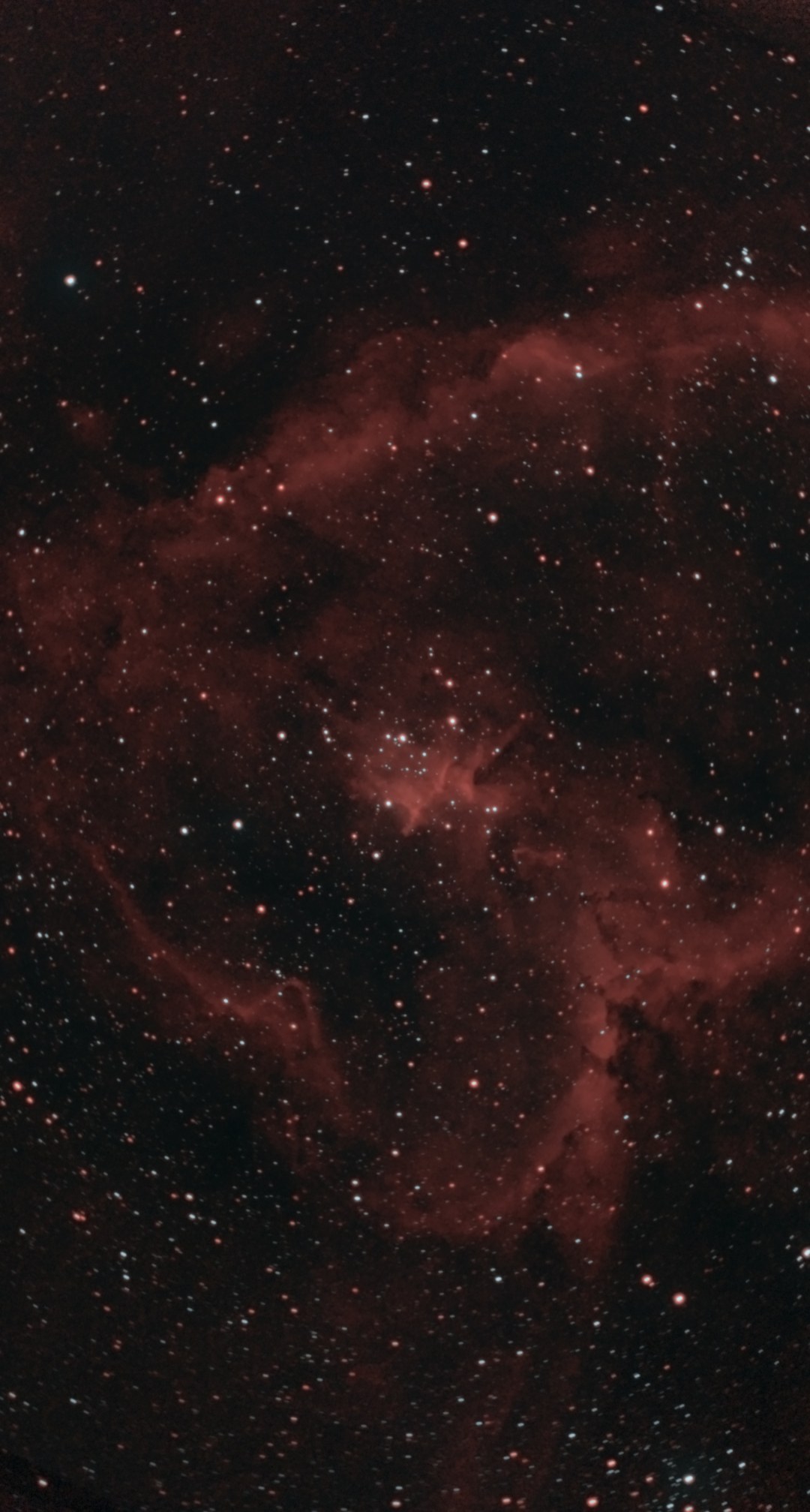
IC 1805 — The Heart Nebula
The stars it made are the ones carving its shape
What you're looking at
IC 1805 is an emission nebula in Cassiopeia, about 7,500 light-years out in the Perseus spiral arm — roughly 200 light-years across, covering five full moons of sky. It glows that deep crimson for one reason: hydrogen gas, ionized by the stars inside it, recombining and emitting at exactly 656 nanometers. The dual-band filter passes that wavelength and rejects nearly everything else, which is the only reason a backyard in suburban Texas can see it at all.
The engine is Melotte 15, the young cluster at the center of the frame. Its stars are barely 1.5 million years old, and the biggest approach fifty times the Sun's mass. Their radiation and stellar winds inflate the shell, carve the dark bays, and sculpt the pillars — the heart shape isn't an accident of where gas happens to sit, it's the pressure of the cluster's own stars pushing their birth cloud outward.
Next door, just off this frame, sits IC 1848 — the Soul Nebula. Together they're the Heart and Soul complex, one of the Perseus arm's great star factories, and a natural two-panel project for a field this wide.
The lesson
Every star in Melotte 15 condensed out of this cloud. Now those same stars are the dominant force reshaping it — their radiation carves the bays, drives the shell outward, and decides which pillars survive.
Organizations run on the same physics. The people a unit produces become the pressure acting on it. For a while you're a product of the culture; then, without anyone announcing the transition, you're one of the forces determining what it becomes.
You don't get to opt out of that second phase — the only choice is whether you shape the place deliberately or by accident. The cloud doesn't stay the way you found it either way.
Object data
- Catalog
- IC 1805 · Sharpless 2-190
- Constellation
- Cassiopeia
- Type
- Emission nebula (H II region)
- Distance
- ~7,500 light-years
- Size
- ~200 light-years — five full moons of sky
- Central cluster
- Melotte 15 — stars up to ~50× the Sun’s mass
- Integration
- 208 × 60s — deepest single-session stack yet
More from the journal
One photo. One lesson.
New entries land when the sky cooperates. Get them by email — no schedule, no spam, just what the telescope caught and what it taught.