
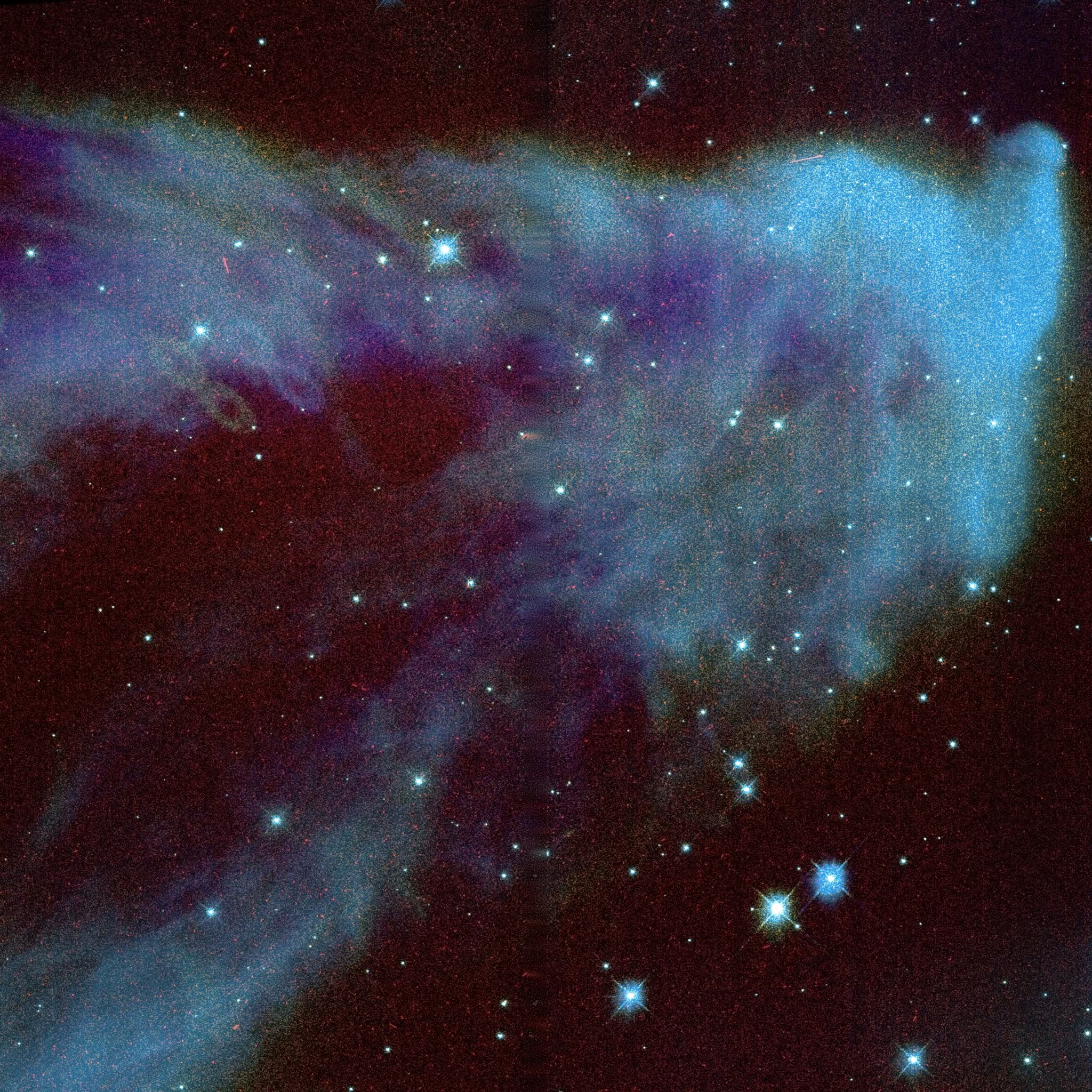
IC63 — The Ghost, Up Close
Hubble on the Ghost of Cassiopeia — reprocessed from the raw archive through my own pipeline
What you're looking at
IC63 is a wisp of gas and dust about 550 light-years away, and it is actively being destroyed. The hooked shape isn't sculpted by anything in this picture — the sculptor is Gamma Cassiopeiae, a blue subgiant star 19,000 times brighter than the Sun sitting two degrees outside the frame, whose ultraviolet radiation is boiling the ghost away from the top down.
The blue glow is starlight from that same unseen star scattering off dust; the red fringe is hydrogen fluorescing under its ultraviolet — the ghost converts the radiation that's destroying it into the light that makes it visible.
In a few tens of thousands of years there will be no ghost here at all. This is a portrait of something mid-erasure.
The lesson
Everything that shapes this picture is outside the frame. The star carving the ghost, lighting it, and erasing it sits two degrees away — you will never see cause and effect in the same shot.
Most situations read the same way. The org chart you can see is the ghost; the forces shaping it — the budget decision three levels up, the customer who threatened to walk, the quiet sponsor — sit outside the frame. Reading the visible shape without asking what's shaping it is how you misread every room.
When something holds a strange shape, go find its Gamma Cassiopeiae.
Object data
- Catalog
- IC63 · the Ghost of Cassiopeia
- Constellation
- Cassiopeia
- Type
- Reflection + emission nebula, being photo-evaporated
- Distance
- ~550 light-years
- The sculptor
- Gamma Cassiopeiae — 19,000× the Sun, outside the frame
- Telescope
- Hubble WFC3/UVIS · proposal 14186 (archival)
- Filters → color
- F475W → B · F625W → G · F814W → R (true RGB)
- Companion entry
- /astronomy/ic63-ghost-of-cassiopeia — my own Seestar capture
More from the journal
One photo. One lesson.
New entries land when the sky cooperates. Get them by email — no schedule, no spam, just what the telescope caught and what it taught.