
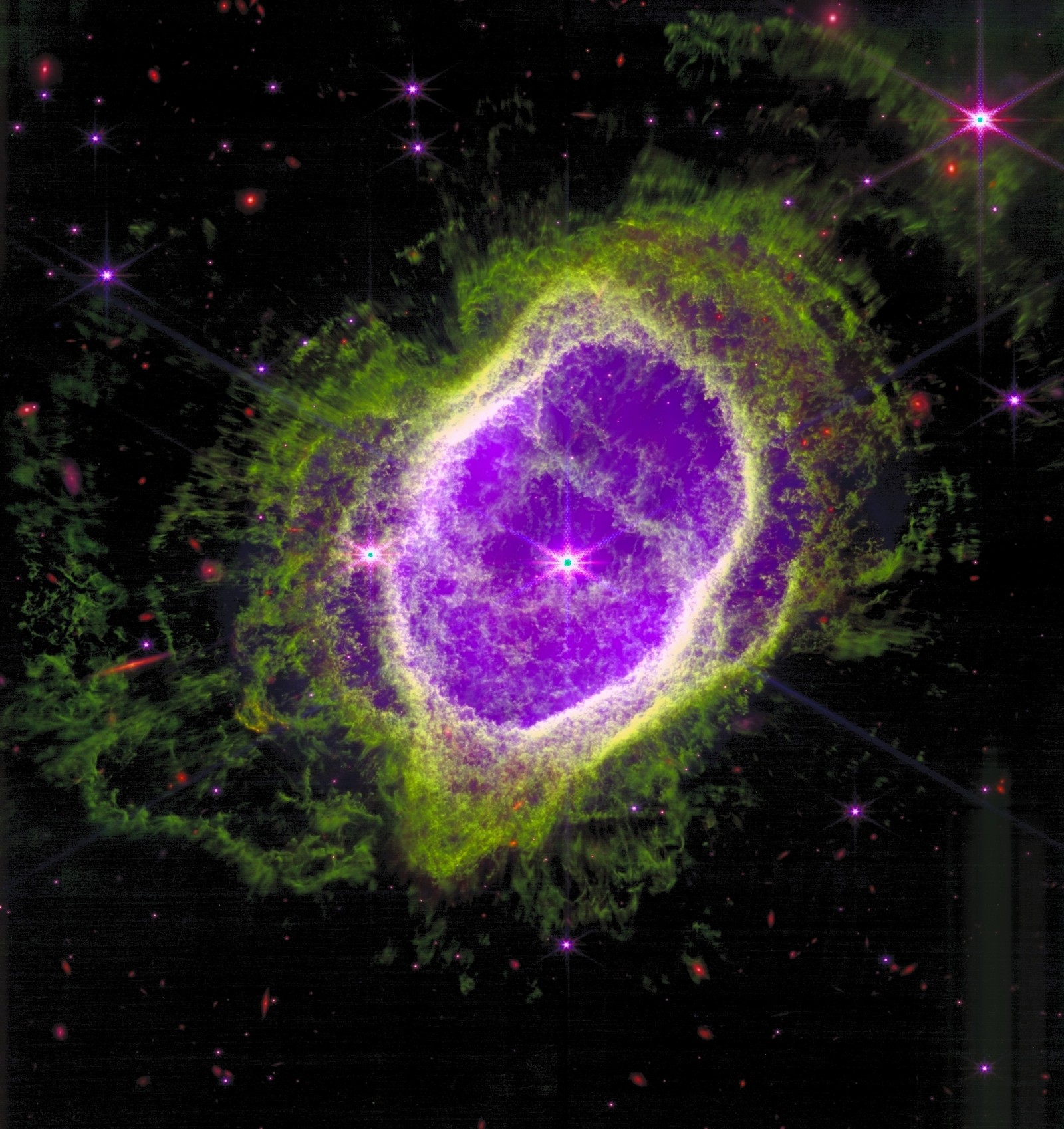
NGC 3132 — The Southern Ring Nebula
A dying star's last act — a JWST first-light image, reprocessed through my own pipeline
What you're looking at
A planetary nebula about 2,500 light-years away in Vela — a dying Sun-like star's final act, blowing off its outer layers in expanding shells of gas and dust roughly half a light-year across. It was one of JWST's very first released images, in July 2022.
There are two stars at the center, and the obvious bright one is a decoy: it's a companion. The star that actually made this nebula is the faint, dim one beside it — a dying star near the end of its life, cloaked in the dust it has been shedding. JWST's infrared cut straight through that dust to reveal it for the first time.
The shells aren't smooth. Each ring and arc is a separate pulse of material thrown off at a different moment, so reading them outward is like reading tree rings backward through the star's final few thousand years.
The lesson
The bright star in the middle is not the one that made this. The nebula was built by the faint, dim star beside it — the one actually dying.
It's the easiest mistake there is: to credit the luminous thing at the center. But the work that built what you're admiring was usually done by someone dimmer, off to the side, quietly spending themselves to do it. Look again at who's doing the real dying.
And what that faint star leaves behind is half a light-year of structured, glowing gas — a legible record of its last few thousand years. Not a bad thing to leave on the way out.
Object data
- Catalog
- NGC 3132 · the Southern Ring · the "Eight-Burst" Nebula
- Constellation
- Vela (southern sky — not visible from Texas)
- Type
- Planetary nebula
- Distance
- ~2,500 light-years
- Size
- ~0.5 light-year across
- The maker
- The faint central star (a dying star), not the bright one
- Telescope
- JWST NIRCam (archival)
- Filters → color
- F090W → B · F212N → G · F356W → R
- Data source
- NASA/ESA/CSA/STScI, MAST archive (public domain)
- Processing
- The same pipeline I run on my Seestar frames
More from the journal
One photo. One lesson.
New entries land when the sky cooperates. Get them by email — no schedule, no spam, just what the telescope caught and what it taught.