
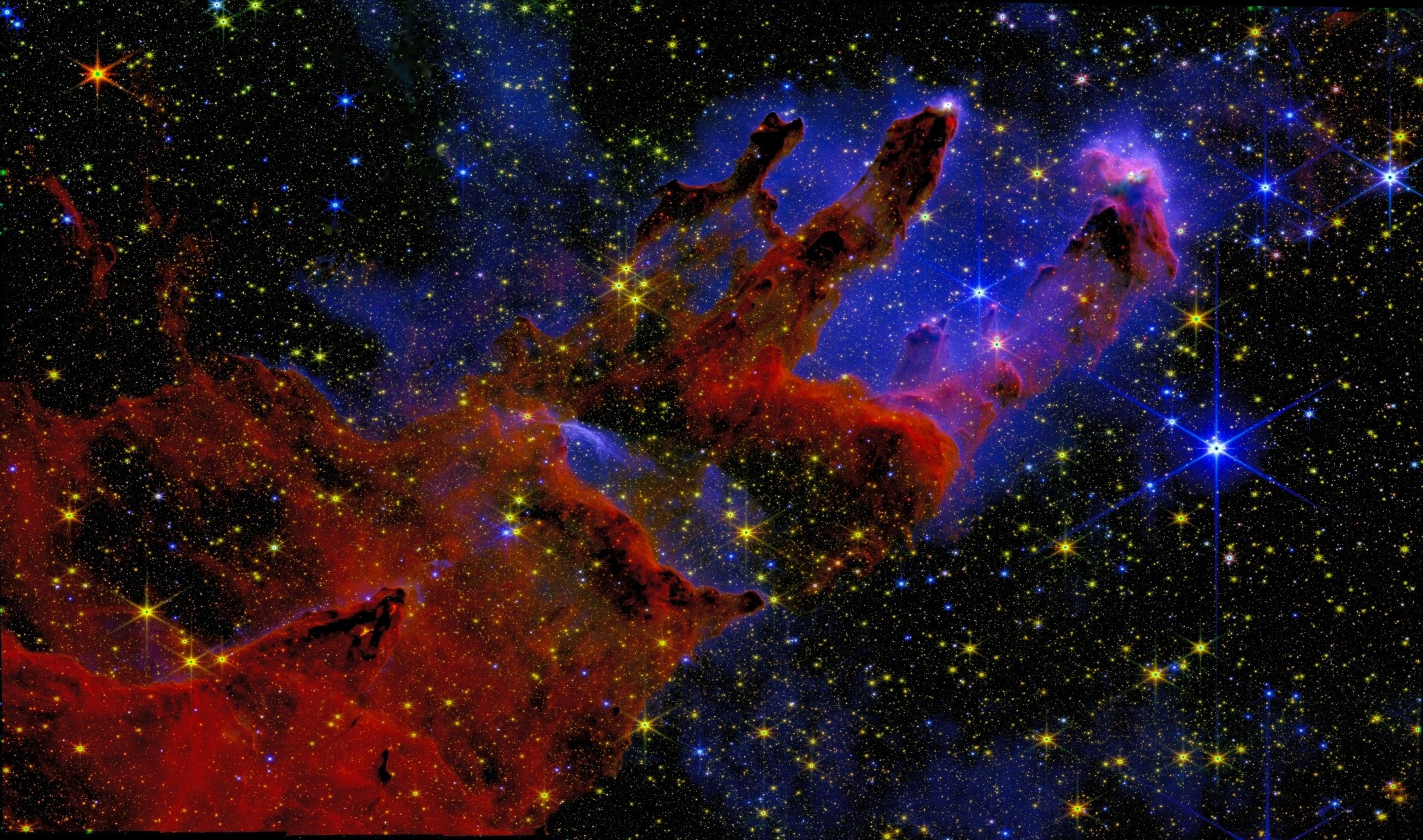
M16 — The Pillars of Creation
The most famous shape in the sky — reprocessed from the JWST archive through my own pipeline
What you're looking at
These are the towers that made astronomy famous: columns of cold molecular gas and dust, several light-years tall, in a star-forming region of the Eagle Nebula about 6,500 light-years away. Hubble made them an icon in 1995; this is JWST's infrared view of the same structures.
The pillars are being built and destroyed in the same motion. Intense ultraviolet light and winds from hot young stars just above the frame are eroding and boiling away the gas — and that same pressure squeezes pockets deep inside the columns dense enough to ignite as new stars. The crimson glints at the pillar tips are exactly that: stars switching on inside the thing being torn apart.
There's a haunting coda. Some astronomers think a supernova may already have shredded the pillars roughly 6,000 years ago — but the light carrying that news hasn't reached Earth yet. We may be photographing a structure that no longer exists.
The lesson
The most monumental, permanent-looking shape in the sky is actually a countdown — actively evaporating, and possibly already gone.
What looks like a fixed monument is almost always a process caught mid-frame. The market position, the org chart, the thing that feels solid and settled — it's eroding and creating at the same time, and the window you're seeing it in is shorter than it looks.
So build and ship while the pillars still stand. The light that tells you they're gone is always already on its way.
Object data
- Catalog
- M16 · the Eagle Nebula · "Pillars of Creation"
- Constellation
- Serpens (Cauda)
- Type
- Emission nebula + star cluster (NGC 6611)
- Distance
- ~6,500 light-years
- Pillar height
- Several light-years (tallest ~4 ly)
- Made famous by
- Hubble, 1995
- Telescope
- JWST NIRCam (archival)
- Filters → color
- F090W → B · F200W → G · F444W → R
- Data source
- NASA/ESA/CSA/STScI, MAST archive (public domain)
- Processing
- The same pipeline I run on my Seestar frames
More from the journal
One photo. One lesson.
New entries land when the sky cooperates. Get them by email — no schedule, no spam, just what the telescope caught and what it taught.