
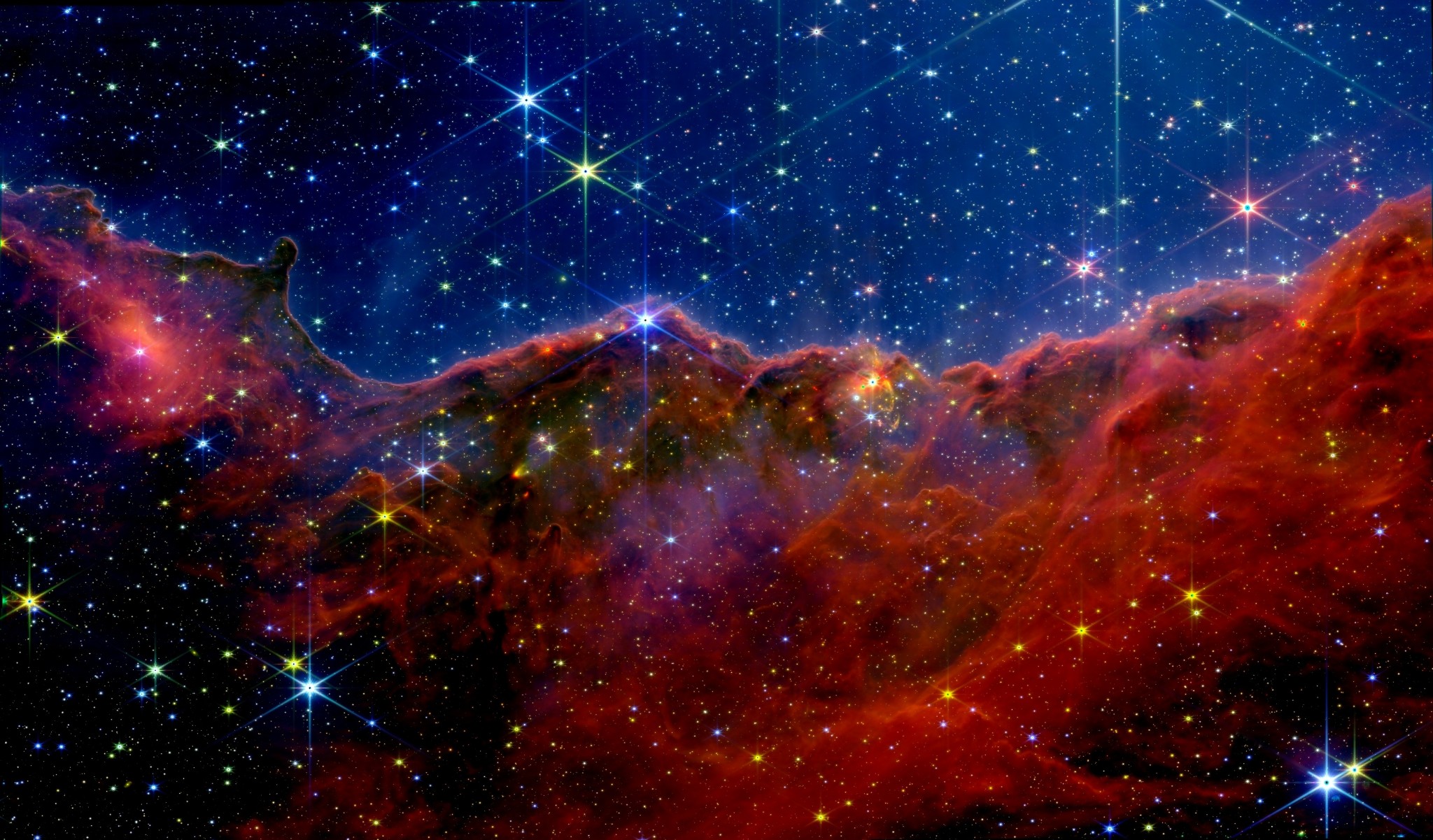
NGC 3324 — The Cosmic Cliffs
JWST's most famous frame — pulled from the public archive and run through my own pipeline
What you're looking at
This is the edge of a cavity. Above the top of the frame — just out of view — sits a cluster of enormous, blazing-hot young stars. Their ultraviolet radiation and stellar winds have hollowed out a vast bubble in the gas cloud they were born in, and what you're seeing is the eroding wall of that bubble: the "cliffs" are the boundary where the blast meets the cloud. The tallest peaks are about seven light-years high.
The wisps that look like steam coming off the ridge are exactly that in spirit — gas and dust being heated, ionized, and boiled away by the radiation pouring down from above. NGC 3324 sits about 7,600 light-years away, in the same vast Carina complex as the nebula I shot from my own backyard.
The reason to point JWST here is that infrared sees through dust that stops visible light cold. Buried in that glowing wall are dozens of newborn stars and narrow jets that no optical telescope could show — stars being triggered into existence at the very edge that's being destroyed. The six-pointed spikes on the bright stars are JWST's signature, the diffraction pattern of its hexagonal mirror segments and secondary-mirror struts.
The lesson
Everything in this picture happens at one boundary: the exact line where the cloud is being torn apart is also the line where new stars are being born. Destruction and creation aren't two regions here — they're the same edge, viewed up close.
That's the frontier, in any field. The place where the old structure is eroding is precisely where the new thing forms. If you want to be where things are being created, go stand at the edge that's under the most pressure.
And a quieter lesson, about this specific image: it's the same pipeline that processes a $500 backyard telescope's data, pointed at a $10-billion observatory's raw files. The tools you build for yourself can reach a great deal further than the problem you built them for. That's the whole wager of learning to build.
Object data
- Catalog
- NGC 3324 · the Cosmic Cliffs · in Carina
- Constellation
- Carina (southern sky — not visible from Texas)
- Type
- Emission nebula / star-forming cavity wall
- Distance
- ~7,600 light-years
- Cliff height
- ~7 light-years, tallest peaks
- Telescope
- JWST NIRCam (archival)
- Filters → color
- F090W → B · F200W → G · F444W → R
- Data source
- NASA/ESA/CSA/STScI, MAST archive (public domain)
- Processing
- The same pipeline I run on my Seestar frames
More from the journal
One photo. One lesson.
New entries land when the sky cooperates. Get them by email — no schedule, no spam, just what the telescope caught and what it taught.