
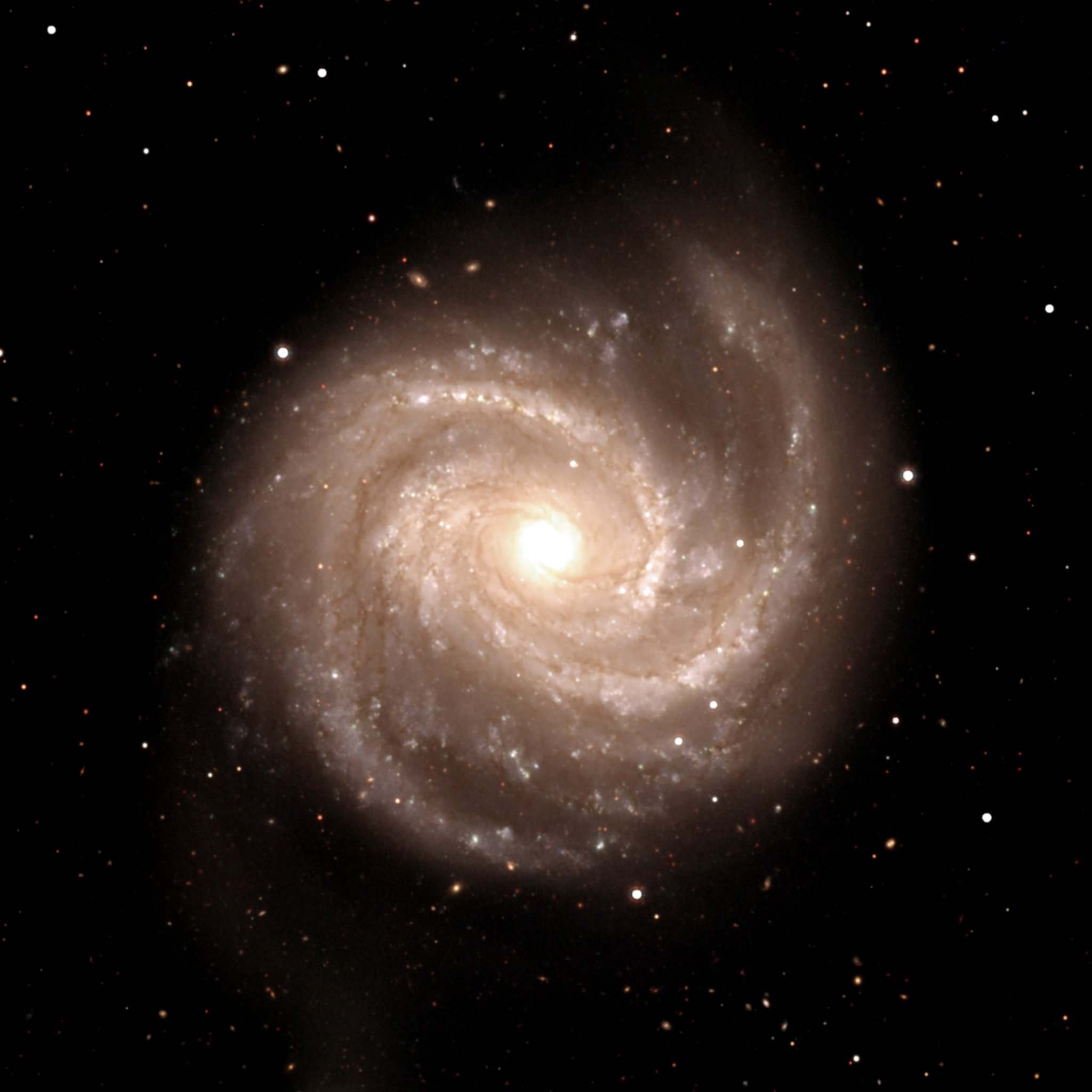
M100 — The Grand Design, at Survey Depth
Two perfect spiral arms, 55 million light years away — rebuilt from raw survey data
What you're looking at
M100 is one of the finest examples of a grand-design spiral — a galaxy whose entire disk is organized into two dominant, symmetrical arms. It sits about 55 million light years away in the Virgo Cluster, and it's close to a face-on twin of our own Milky Way in size and mass. In 1994, Hubble astronomers used pulsating stars in M100 to make one of the first precise measurements of the universe's expansion rate.
Here's the strange part about those beautiful arms: they aren't objects. The arms are density waves — compression zones that move through the disk the way a traffic jam moves down a highway. Individual stars drift in and out of the arms as they orbit; the jam persists while every car in it changes.
The bright knots strung along the arms are star-forming regions, triggered where gas piles up as it passes through the wave. The arms are simultaneously the galaxy's most permanent feature and made of nothing permanent at all.
The lesson
The spiral arms are traffic jams: the pattern persists while every star in it flows through.
That's a military unit. The squadron you left still exists — same name, same patch, same reputation — and not one person you served with is still in it. The unit was never the people. It was the pattern the people moved through, and the pattern did something to everyone who passed through it.
Veterans mourn leaving the unit. But you were never meant to stay in the wave — you were meant to be shaped by the compression and carry the momentum out the other side. The jam stays. The cars drive on.
Object data
- Catalog
- M100 · NGC 4321
- Constellation
- Coma Berenices
- Type
- Grand-design spiral galaxy
- Distance
- ~55 million light-years
- Diameter
- ~107,000 light-years — a near-twin of the Milky Way
- Cluster
- Virgo Cluster
- Telescope
- Víctor M. Blanco 4-m · DECam (archival)
- Companion entry
- /astronomy/m100 — my own 26-minute Seestar capture of the same galaxy
More from the journal
One photo. One lesson.
New entries land when the sky cooperates. Get them by email — no schedule, no spam, just what the telescope caught and what it taught.