
M101 — The Pinwheel, the Hard Way
Three broken data tiles, two telescopes, and a defect that turned out to be the galaxy
What you're looking at
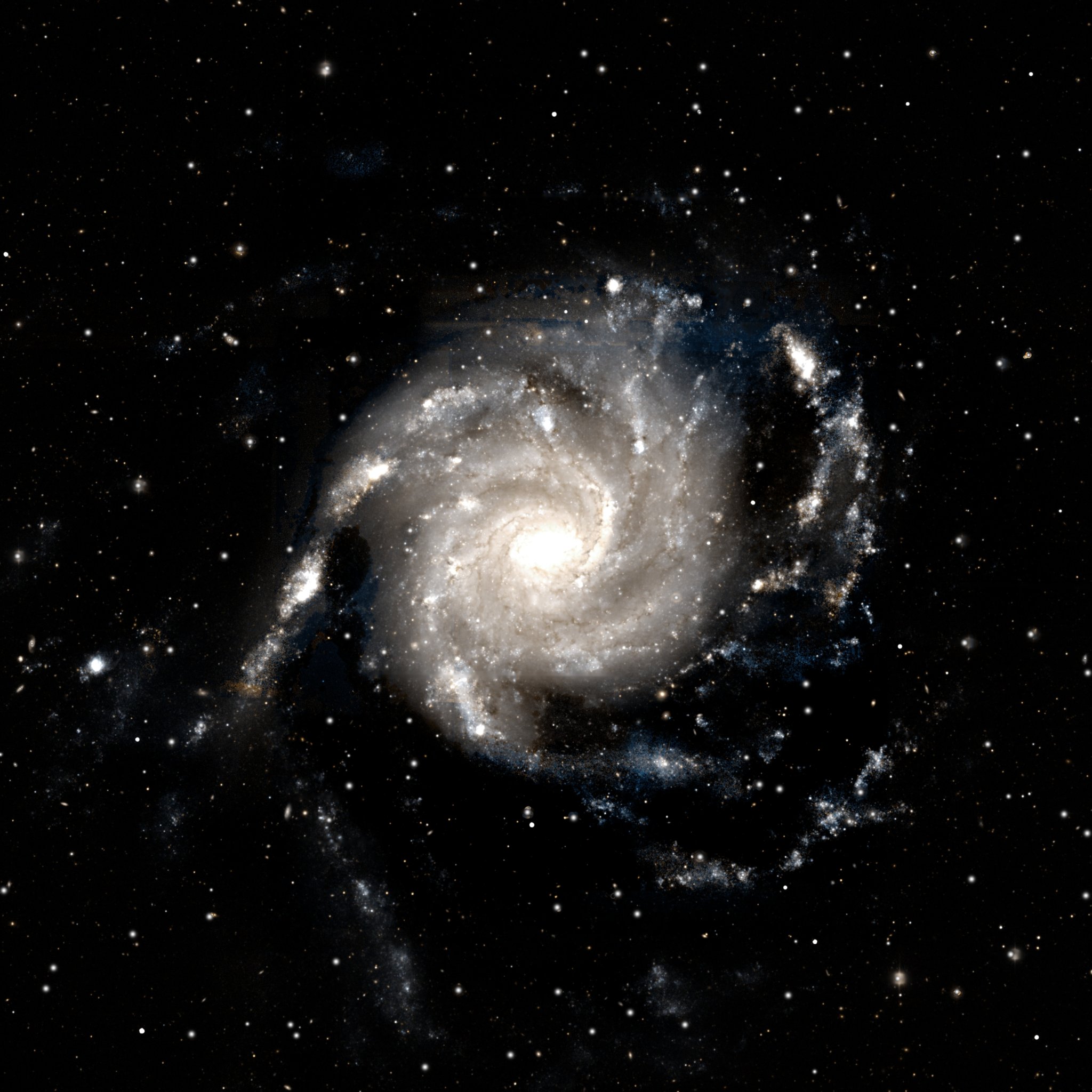
M101 is enormous — about 70% larger than the Milky Way, 21 million light years away, and tilted perfectly face-on, which is why it earns the name Pinwheel. At survey depth its arms resolve into hundreds of individual star-forming regions, several of which are so bright they carry their own NGC catalog numbers, assigned in the 1800s when astronomers mistook them for separate nebulae.
Look at the western (left) side: the arm pattern breaks. There's a genuine dark gap where the spiral rhythm stumbles — M101 is one of the most lopsided large spirals known, yanked out of symmetry by gravitational encounters with its companion galaxies. The asymmetry isn't a flaw in the image. It's the galaxy's biography, written in its shape.
And that gap is the point of this entry's story. In the first version of this image, built on broken data, the gap looked like an obvious processing defect — an opaque hole. I spent hours trying to repair it. The fix came from checking a second, completely independent telescope: Pan-STARRS sees the same dark gap. Two unrelated instruments agreeing means the anomaly is in the sky, not the camera.
The lesson
I spent hours trying to fix a defect that turned out to be the galaxy.
The broken early versions of this image exaggerated a real feature — M101's genuine lopsidedness — into something that looked like damage. Every repair attempt made the picture worse, because the thing I was repairing wasn't broken. The answer came from an independent reference: a second telescope that sees the same sky confirmed the gap is real.
Veterans do this to themselves constantly. You hold your record up against the corporate template, and the parts that don't match — the nonlinear path, the weird specialty, the gap the military carved into you — look like defects to fix, sand down, or hide. Check an independent reference first: the people who know your work. Some of what you're trying to repair is your actual shape, and the shape is the story.
Fix what's broken. Keep what's you. The skill is telling them apart — and you usually can't do it alone.
Object data
- Catalog
- M101 · NGC 5457 · the Pinwheel
- Constellation
- Ursa Major
- Type
- Face-on spiral, strongly lopsided
- Distance
- ~21 million light-years
- Diameter
- ~170,000 light-years — ~70% larger than the Milky Way
- Telescopes
- Bok 2.3-m (BASS) + Pan-STARRS 1.8-m (archival)
- Data verdict
- 3 of 9 survey tiles defective; the dark western gap is real — confirmed by two independent surveys
- Companion entries
- /astronomy/m101 (Bortle 6) and /astronomy/m101-dark-sky (Bortle 2) — my own Seestar captures
More from the journal
One photo. One lesson.
New entries land when the sky cooperates. Get them by email — no schedule, no spam, just what the telescope caught and what it taught.