
NGC 4565 — The Needle Galaxy
What the Milky Way would look like from outside — rebuilt from raw survey data
What you're looking at
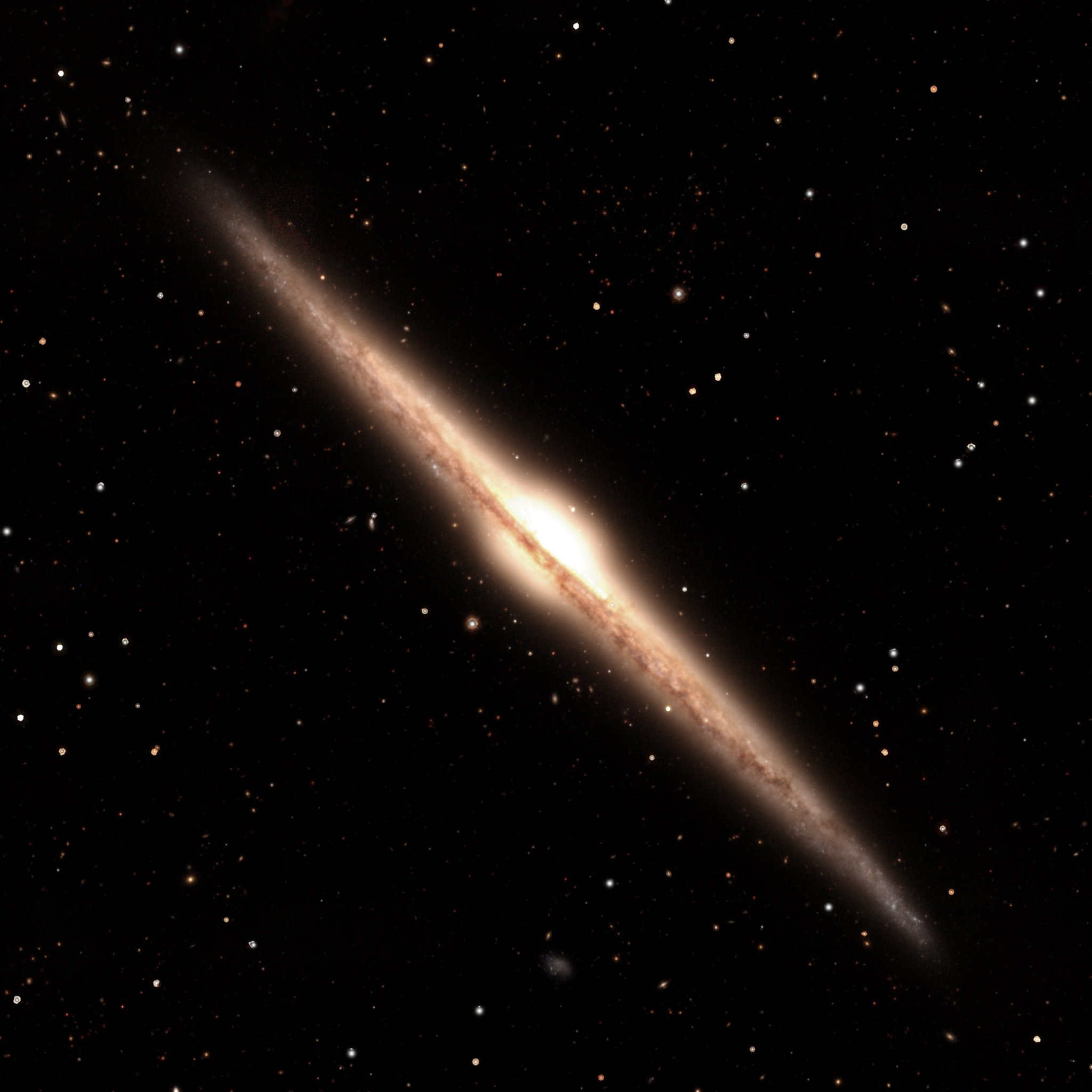
NGC 4565 is a spiral galaxy roughly the size of the Milky Way, about 40 million light years away — and we happen to see it exactly edge-on. The entire grand spiral structure compresses into a single luminous line nearly 16 arcminutes long, with the dust that would trace elegant arms face-on instead cutting the galaxy lengthwise as one dark lane.
The central bulge bulges through the dust like a lens — look closely and it's slightly boxy, the signature of a barred spiral seen from the side. Many astronomers' best guess for what the Milky Way looks like from outside is: very nearly this.
And that's the catch — we will never check. Every map of our own galaxy is assembled from the inside, star by star, because no camera we can build will ever stand far enough away. The only way we know our own shape is by studying galaxies like this one.
The lesson
We live inside the Milky Way and have never seen it. Every picture of 'our galaxy' is an artist's rendering, informed by edge-on mirrors like NGC 4565. You learn your own shape by studying things that resemble you — from a vantage point you can never occupy yourself.
You can't see your own career from outside either. Your self-assessment is assembled from the inside, one biased star count at a time. The people who read you accurately — mentors, peers, the veterans two years ahead of you on the same path — are your edge-on galaxies: close enough to resemble you, far enough to see the shape.
So collect them deliberately. Every honest outside read you get is a photograph of yourself from a distance you'll never reach alone.
Object data
- Catalog
- NGC 4565 · Caldwell 38 · the Needle
- Constellation
- Coma Berenices
- Type
- Barred spiral, seen exactly edge-on
- Distance
- ~40 million light-years
- Apparent length
- ~16 arcminutes — half the Moon's width
- Discovery
- 1785 · William Herschel
- Telescope
- Víctor M. Blanco 4-m · DECam (archival)
- Fun fact
- Often called the finest galaxy Messier missed
More from the journal
One photo. One lesson.
New entries land when the sky cooperates. Get them by email — no schedule, no spam, just what the telescope caught and what it taught.