
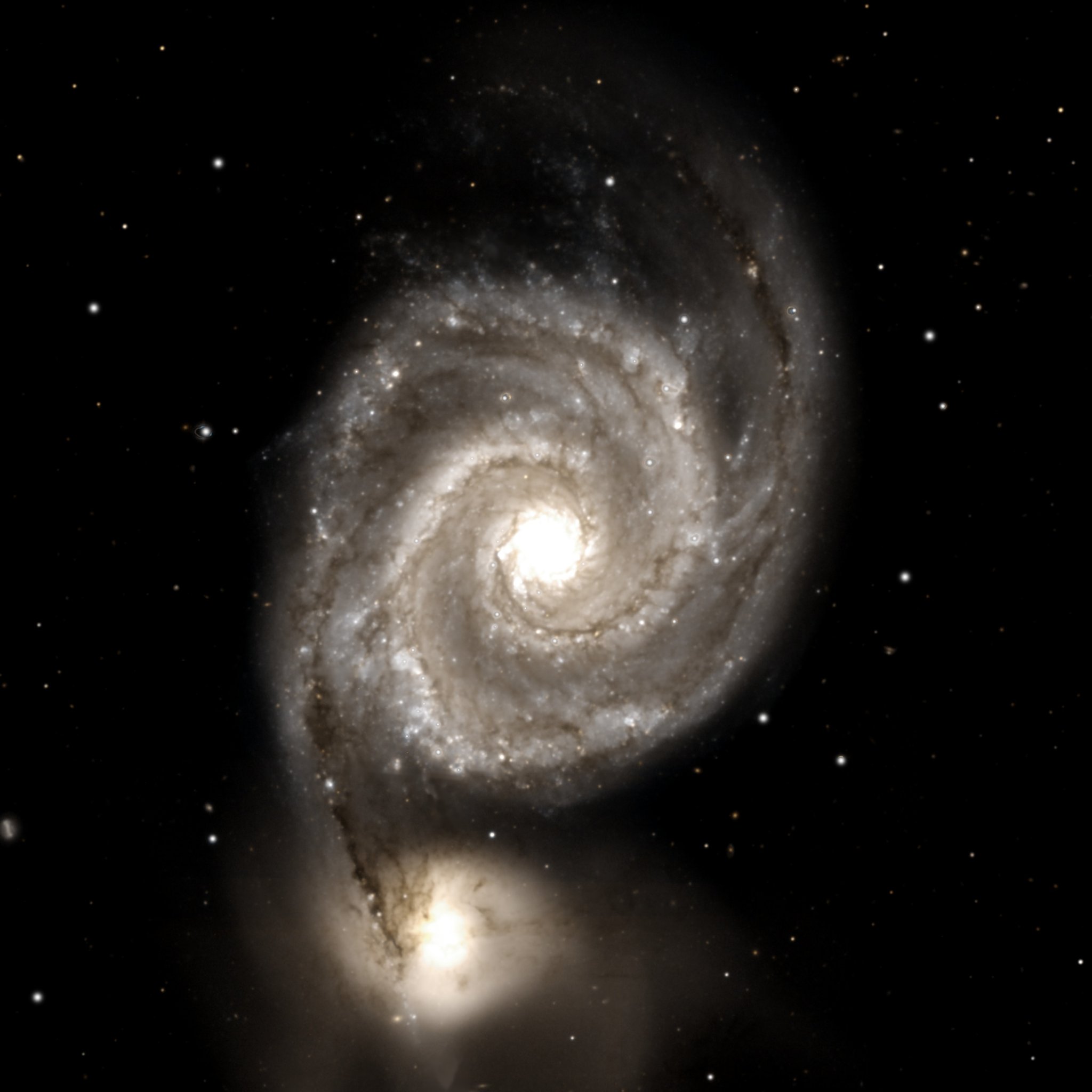
M51 — The Whirlpool, Rebuilt from Two Colors
A professional telescope with a broken filter, and the honest way out
What you're looking at
This is the same galaxy pair as my backyard Whirlpool capture — M51 and its doomed companion NGC 5195 — but at survey depth the collision becomes legible. The spiral arms resolve into chains of individual star-forming regions, the tidal bridge between the galaxies is unmistakable, and faint debris thrown off by the encounter glows around both.
NGC 5195 has already made at least two passes through M51's disk. Each pass drives the density waves that make M51's arms so unusually crisp — the companion is, in a real sense, the author of the Whirlpool's beauty, and it's being shredded for it.
A note on the color: professional survey telescopes image the sky one filter at a time. In this field, the infrared-side data was unusable — so this image is built from the blue-green and red filters only. That's why its palette is silvery and restrained compared to the DECam images in this series. It's not a style choice. It's the honest rendering of the data that actually exists.
The lesson
One of the survey's three filters was broken across this whole field. I spent hours trying to repair it — modeled it, patched it, reconstructed it from the other two. Every version looked worse than admitting the truth: the data wasn't there.
The version you're looking at uses two colors instead of three, and it's better than every faked three-color version that preceded it.
There's a strong pull — in imaging, in briefings, in business plans — to present the full picture even when part of it doesn't exist. The discipline that actually builds trust is the opposite: show exactly what you have, label exactly what's missing, and let the work stand on the honest subset. Two real colors beat three where one is invented. Every audience can eventually tell.
Object data
- Catalog
- M51 · NGC 5194 + NGC 5195
- Constellation
- Ursa Major
- Type
- Interacting grand-design spiral + dwarf companion
- Distance
- ~23 million light-years
- Telescope
- Bok 2.3-m · BASS (archival)
- Filters used
- g + r only — the z-band was defective across this field
- Companion entry
- /astronomy/m51 — my own 73-minute Seestar capture of the same pair
More from the journal
One photo. One lesson.
New entries land when the sky cooperates. Get them by email — no schedule, no spam, just what the telescope caught and what it taught.