
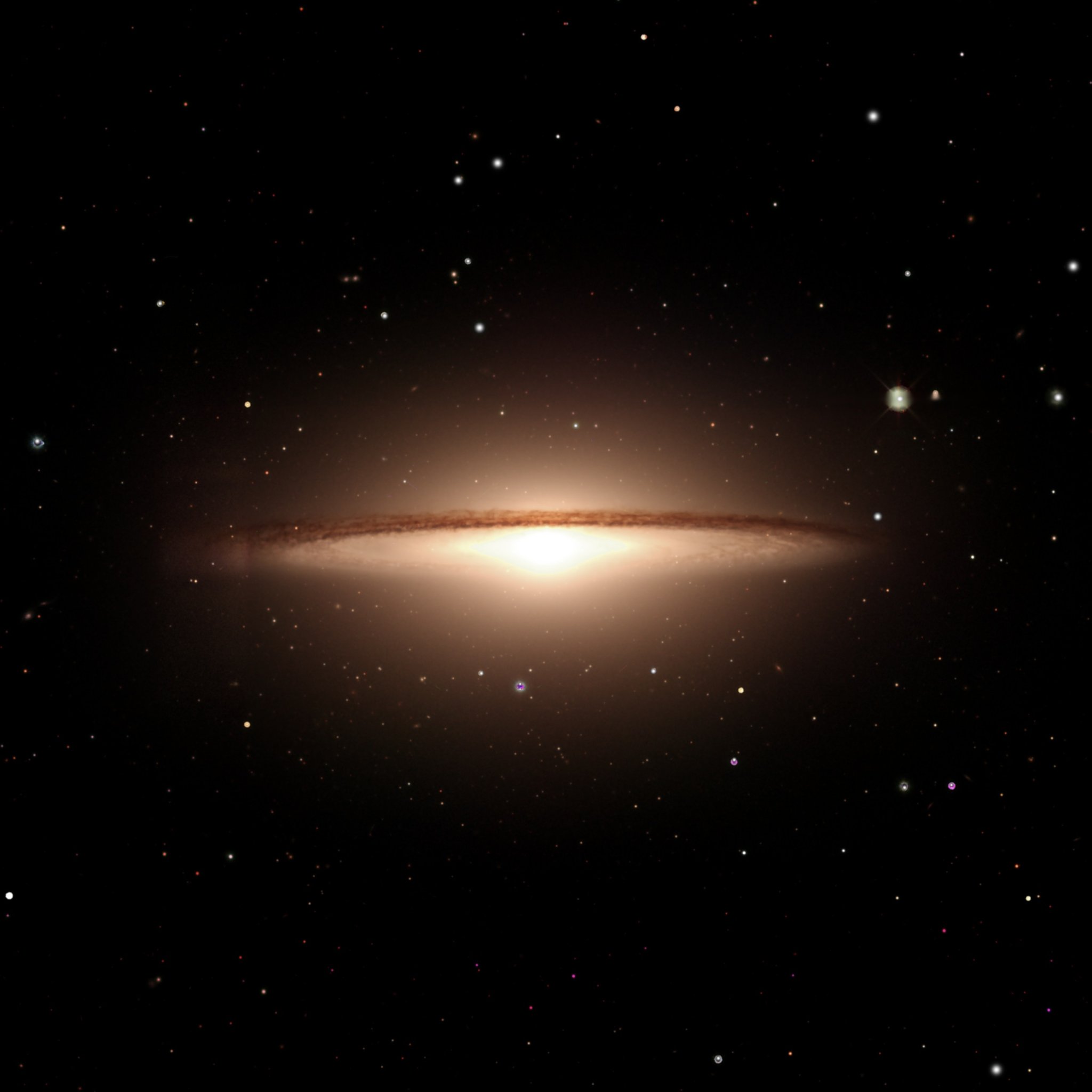
M104 — The Sombrero, at Survey Depth
A galaxy that is mostly invisible — rebuilt from raw survey data
What you're looking at
The Sombrero sits about 29 million light years away, tilted just six degrees from edge-on, so its brilliant bulge and dark dust ring read like a wide-brimmed hat. It's one of the most massive objects within that distance — and most of what makes it massive is invisible in this picture.
Start with what you can't see: a halo of dark matter and old stars extending far beyond the visible glow, roughly 2,000 globular clusters (the Milky Way has about 150), and at the center, one of the most massive black holes in our neighborhood — about a billion times the mass of the Sun, quiet for now.
The crisp ring you can see is where most of the galaxy's cold gas and dust lives, and it's the only part still forming stars. The glowing bulge is ancient — a vast, settled population of old stars shining with the accumulated light of billions of years.
The lesson
Everything that makes the Sombrero formidable is missing from its photo. The dark-matter halo, the two thousand globular clusters, the billion-solar-mass black hole — invisible. What photographs is the bright rim.
A résumé is a photo of a career, and it has the same problem: it captures the luminous ring — titles, dates, bullet points — and misses the mass. The judgment built from a hundred hard calls, the people who trust you, the reputation that precedes you into a room. The things that actually hold a career together don't photograph.
Two moves follow. Don't judge your own worth by your photo. And when you evaluate others — hiring, partnering, promoting — remember you're looking at the rim and weighing the halo.
Object data
- Catalog
- M104 · NGC 4594 · the Sombrero
- Constellation
- Virgo
- Type
- Peculiar spiral, seen 6° from edge-on
- Distance
- ~29 million light-years
- Central black hole
- ~1 billion solar masses
- Globular clusters
- ~2,000 (the Milky Way has ~150)
- Telescope
- Víctor M. Blanco 4-m · DECam (archival)
- Companion entry
- /astronomy/m104 — my own Seestar capture of the same galaxy
More from the journal
One photo. One lesson.
New entries land when the sky cooperates. Get them by email — no schedule, no spam, just what the telescope caught and what it taught.