
The Veil — The Shock Front, Up Close
One filament of the supernova remnant I shoot from the backyard — at Hubble's resolution
What you're looking at
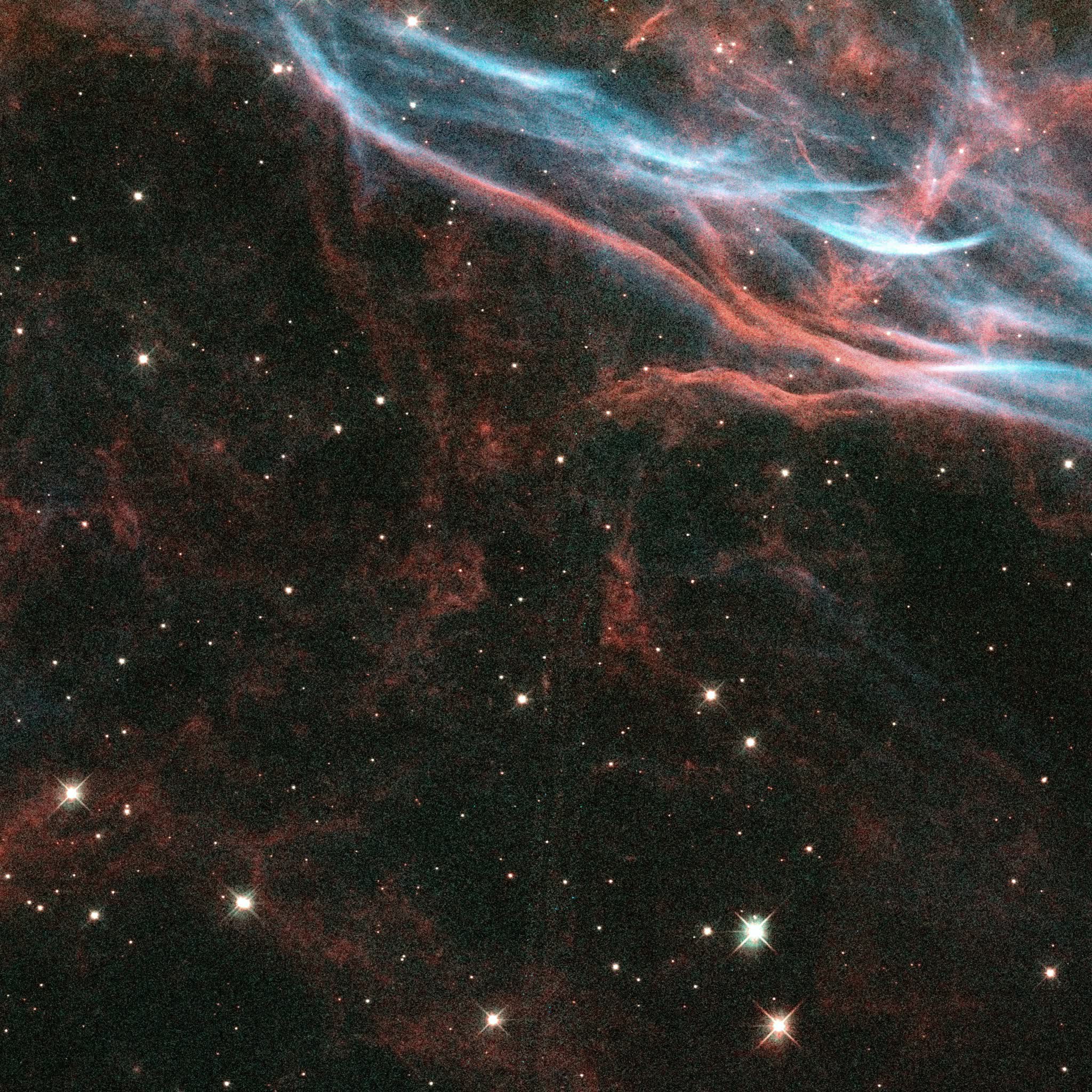
This is the blast wave of a star that exploded about ten thousand years ago, photographed from inside the explosion's own timeline: the braided ribbon crossing the top of the frame is the shock front, moving at hundreds of kilometers per second, seen edge-on where the sheet of glowing gas folds along the line of sight.
The colors are the physics. Teal is oxygen heated to collapse right at the shock; red is hydrogen and sulfur recombining in the cooler gas behind it. Every braid and fold maps where the wave has already passed.
Look below the ribbon: that dark, faintly laced region is the interstellar cloud the shock hasn't reached yet. The lower half of this picture doesn't know about the explosion. In a few thousand years, it will.
The lesson
The bottom half of this image hasn't heard the news yet. The shock front — all the light, all the drama — is exactly the line where the information arrives, and below it the cloud sits dark and unchanged, running on the old reality.
Industries work the same way. Disruption isn't a moment, it's a front that propagates — some corners get hit years before others. The companies in the dark half aren't safe; they're just later on the shock's path.
You can't stop the wave. But unlike the gas, you can look up, see the glowing line coming, and choose to meet it ready.
Object data
- Catalog
- Veil Nebula / Cygnus Loop (NGC 6960 region)
- Constellation
- Cygnus
- Type
- Supernova remnant — shock front seen edge-on
- Distance
- ~2,400 light-years
- Age
- ~10,000 years since the explosion
- Shock speed
- Hundreds of km per second
- Telescope
- Hubble WFC3/UVIS · proposal 14056 (archival, 2015)
- Filters → color
- [OIII] → teal · Hα/[SII] → red · broadbands → stars
- Companion entries
- /astronomy/ngc6960-witchs-broom and the Veil entries — my own Seestar captures of the same remnant
More from the journal
One photo. One lesson.
New entries land when the sky cooperates. Get them by email — no schedule, no spam, just what the telescope caught and what it taught.